Triviat logo

Triviat

This system routes customer inquiries through a multi-channel intake system that consolidates messages from live chat, email, WhatsApp, phone calls, SMS, and social media into a unified processing ...

26 views
Visit triviat.com
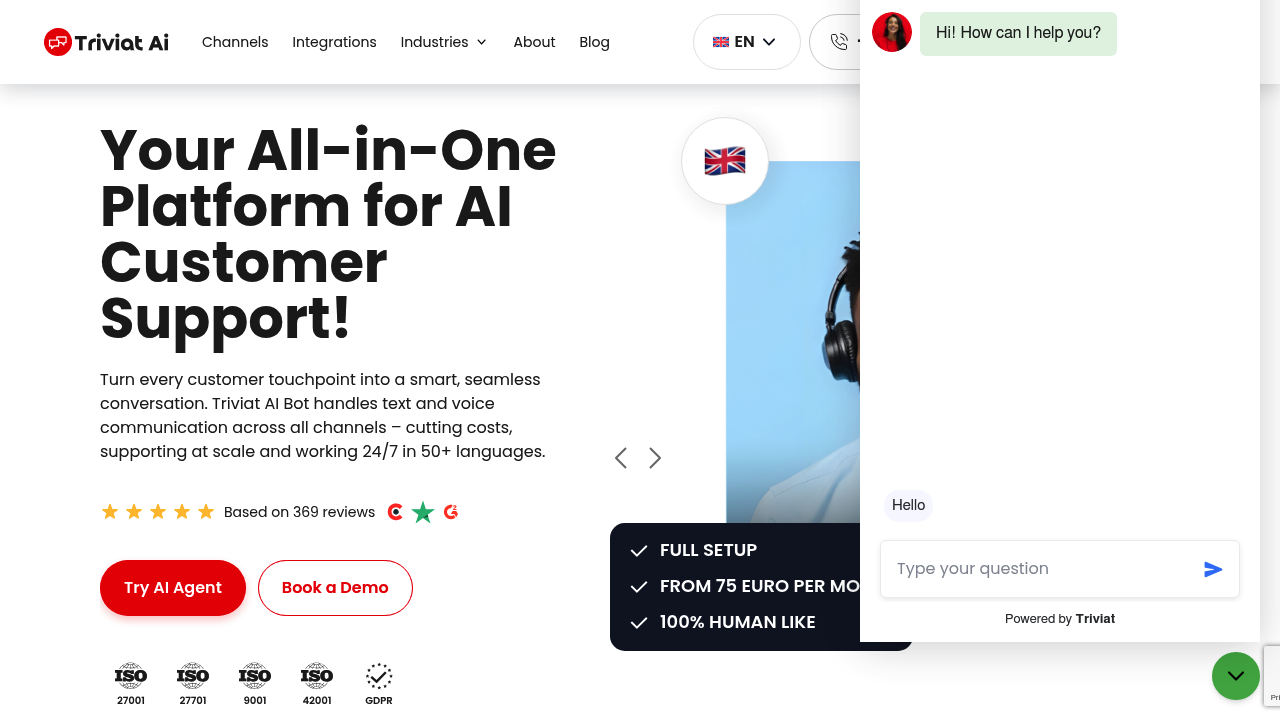
Triviat screenshot

This system routes customer inquiries through a multi-channel intake system that consolidates messages from live chat, email, WhatsApp, phone calls, SMS, and social media into a unified processing pipeline. The AI agent analyzes incoming text or voice communication, determines intent, and generates responses using natural language models trained on the business's specific content and documentation. For voice interactions, the system converts speech to text, processes the query, and converts the response back to speech with customizable voice characteristics.

The data flow starts with channel-specific APIs capturing customer messages. These get normalized into a standard format regardless of origin. The AI then accesses a knowledge base that businesses populate with their own support content, product information, and policies. When the system can't confidently resolve a query, it triggers a handover protocol that transfers the full conversation history to a human agent without requiring the customer to repeat information.

Response quality varies based on how thoroughly businesses train the system with their specific content. The service supports 50+ languages with real-time translation capabilities, though accuracy depends on language pair complexity and domain-specific terminology. The AI maintains conversation context across multiple exchanges within a session. Businesses can adjust the agent's personality and tone through configuration settings that influence response formality and style.

Technical integration happens through APIs that connect with existing business systems. The service works with major cloud infrastructure providers and uses advanced language models for natural language processing. Businesses get access to a real-time dashboard that tracks conversation volume, call duration, automation rates, and cost metrics per interaction. The branded chat widget embeds into websites through JavaScript snippets.

The system reports up to 80% automation of support requests, though this figure likely reflects optimal scenarios rather than guaranteed performance. Actual automation rates depend heavily on query complexity and knowledge base completeness. For enterprise scenarios requiring human intervention, the service connects to a global agent network supporting 30+ languages.

Setup starts at 75 EUR monthly and includes full configuration, system integration, and training. This covers technical implementation rather than usage-based charges.

The service doesn't specify latency benchmarks for response generation or voice processing times. There's no information about data retention policies, API rate limits, or whether the system can handle multimedia attachments beyond text and voice. The handover mechanism's trigger logic isn't detailed, leaving unclear how it decides when human intervention is necessary.

Frequently asked

7 questions
Does Triviat offer a free trial or free plan?
Triviat doesn't offer a free trial or free tier. The service starts at 75 EUR per month, which includes complete setup, configuration, and system integration rather than being a usage-based charge. This pricing model covers the technical implementation work their team handles to get the AI agent running across all your communication channels. Businesses pay upfront for the full service package rather than testing a limited version first.
How does Triviat handle customer conversations across different channels?
Triviat consolidates messages from live chat, email, WhatsApp, phone, SMS, and social media into a unified processing pipeline using channel-specific APIs. Each incoming message gets normalized into a standard format regardless of where it originated, allowing the AI to maintain conversation context without knowing which platform the customer used. When processing voice calls, the system converts speech to text, analyzes the query against the knowledge base, then converts the AI's response back to speech with customizable voice characteristics. The dashboard tracks all interactions in real-time regardless of channel origin.
What languages does Triviat support for customer service?
Triviat's AI handles customer inquiries in 50+ languages with real-time translation capabilities built into the processing pipeline. For enterprise scenarios requiring human agent intervention, the service provides support in 30+ languages through a global agent network. Translation accuracy varies depending on language pair complexity and whether the conversation involves domain-specific terminology that might not translate cleanly. The system processes all languages through the same knowledge base, so response quality depends on how well businesses document their content.
Can Triviat integrate with my existing business systems?
Triviat connects to existing business systems through APIs and works with major cloud infrastructure including Google, Amazon Web Services, OpenAI, and Claude. The integration process is handled by their team as part of the setup service rather than requiring businesses to configure connections themselves. The branded chat widget embeds into websites using JavaScript snippets. However, the documentation doesn't specify API rate limits, supported CRM platforms, or whether the system handles multimedia attachments beyond text and voice.
How does Triviat decide when to transfer a conversation to a human agent?
Triviat transfers conversations to human agents when the AI can't confidently resolve a query, passing along the full conversation history so customers don't repeat themselves. The system's trigger logic for these handovers isn't detailed in the technical documentation, leaving unclear what confidence threshold or specific scenarios prompt human intervention. Businesses using the enterprise-level human agent support get access to a global network covering 30+ languages for high-volume complex scenarios. The handover mechanism appears automated but lacks transparency about its decision-making criteria.
What's the actual automation rate for customer support with Triviat?
Triviat reports up to 80% automation of support requests, though this figure likely reflects optimal scenarios rather than guaranteed performance across all implementations. Actual automation rates depend heavily on query complexity and how thoroughly businesses train the knowledge base with their specific content, product information, and policies. The system works best for straightforward, repetitive inquiries where the AI can match customer questions to documented answers. Complex issues requiring judgment calls or access to systems outside the knowledge base will still need human agents.
What industries and business types use Triviat?
Triviat targets businesses across retail and e-commerce, restaurants, beauty salons, dental clinics, optical shops, travel and entertainment, car services, IT and SaaS, financial services, gaming, transportation, hotels, and real estate. The platform's multi-channel approach works for any business handling customer inquiries through chat, email, phone, WhatsApp, SMS, or social media. Businesses in these sectors typically deal with repetitive support requests about hours, booking, product availability, and basic troubleshooting that AI can handle without human intervention. The 50+ language support particularly benefits companies serving international customers or operating across multiple regions.

Traffic

Estimated monthly website visits · last 0 months

262 visits/mo
Monthly visits
262

Not enough historical data for a chart yet.

Data from SimilarWeb · Updated monthly.

Reviews (0)

Write review

No reviews yet. Be the first to share your experience.

Similar tools

See all →