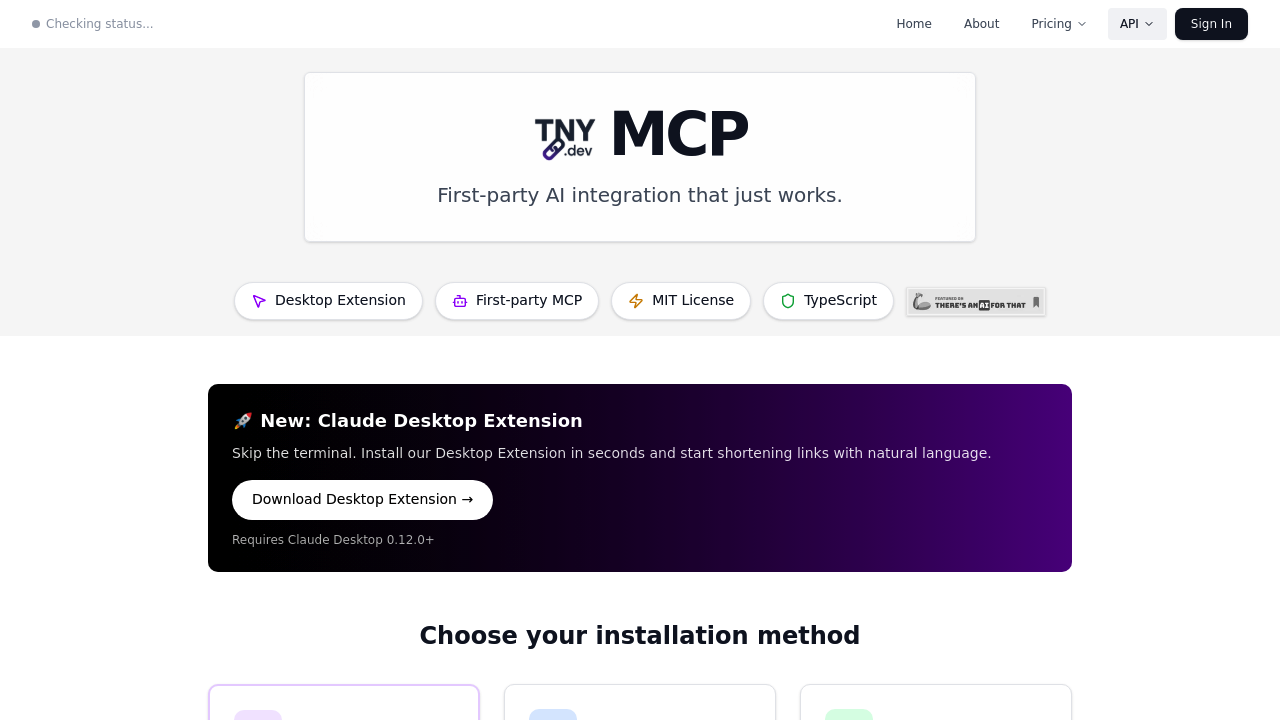
Link shortening gets integrated directly into AI conversations through tny.dev's Model Context Protocol server. Instead of switching to a browser tab to create short links, users ask their AI assistant to handle it. This service responds to natural language requests within the chat interface itself.
The system runs as an official first-party MCP server maintained by tny.dev, not a community project or third-party fork. This means updates come directly from the source, and the integration stays aligned with the core service's development. Three distinct tools get exposed through MCP: shorten_url creates new short links, get_link_analytics pulls click data and metrics, and list_links retrieves existing shortened URLs with pagination support.
Installation happens three different ways depending on technical comfort level. The Desktop Extension method requires zero terminal commands and works through one-click installation with automatic updates built in. Developers get an npm package that allows custom configuration and integration into existing workflows. Power users who want to modify this software itself can pull from the open source GitHub repository, which carries an MIT license.
Custom slugs let users define their own short link endings rather than accepting randomly generated strings. These slugs accept alphanumeric characters, hyphens, and dashes, ranging from three to fifty characters long. When someone wants a custom slug on their own domain, they need to provide a domain ID alongside the slug request. Custom domains themselves require a Developer plan subscription, creating a clear division between basic and advanced usage.
This service claims one hundred percent uptime and reports powering millions of shortened links. Link analytics track click data for each shortened URL, giving users visibility into which links get traffic. Bulk URL processing handles multiple links in single requests rather than forcing one-at-a-time creation. The list_links function supports pagination from one to one hundred items per page, defaulting to twenty when users don't specify a preference.
Integration spans six different AI clients and code editors. Compatible platforms include Cursor, VS Code, Zed, and desktop AI applications that support MCP version 0.12.0 or higher. Any software that supports the Model Context Protocol can theoretically connect to the server, expanding potential use cases beyond the explicitly listed platforms.
The TypeScript implementation means developers working in JavaScript ecosystems can read and modify the source code without learning new languages. The open source nature lets technical users fork the project, add features, or adapt the server to specialized workflows that the base version doesn't address.
Developers who need link shortening woven into AI-powered workflows get the most obvious benefit. Content creators who generate multiple short links daily can handle the task without context switching. Analytics users who track link performance across campaigns can query data through conversational commands. Power users who want to extend functionality can modify the MIT-licensed code to fit specific requirements.
The Desktop Extension requires MCP-compatible desktop applications running version 0.12.0 minimum. Custom domain usage gets locked behind the Developer plan tier, so basic users stick with tny.dev branded short links. Custom slugs require domain IDs when used, adding an extra parameter to the request rather than working standalone.
Natural language processing means users describe what they want instead of filling forms. "Shorten this URL with the slug product-launch" works as a command. The AI agent interprets the request, calls the appropriate MCP tool, and returns the shortened link without manual API calls or web interface navigation.