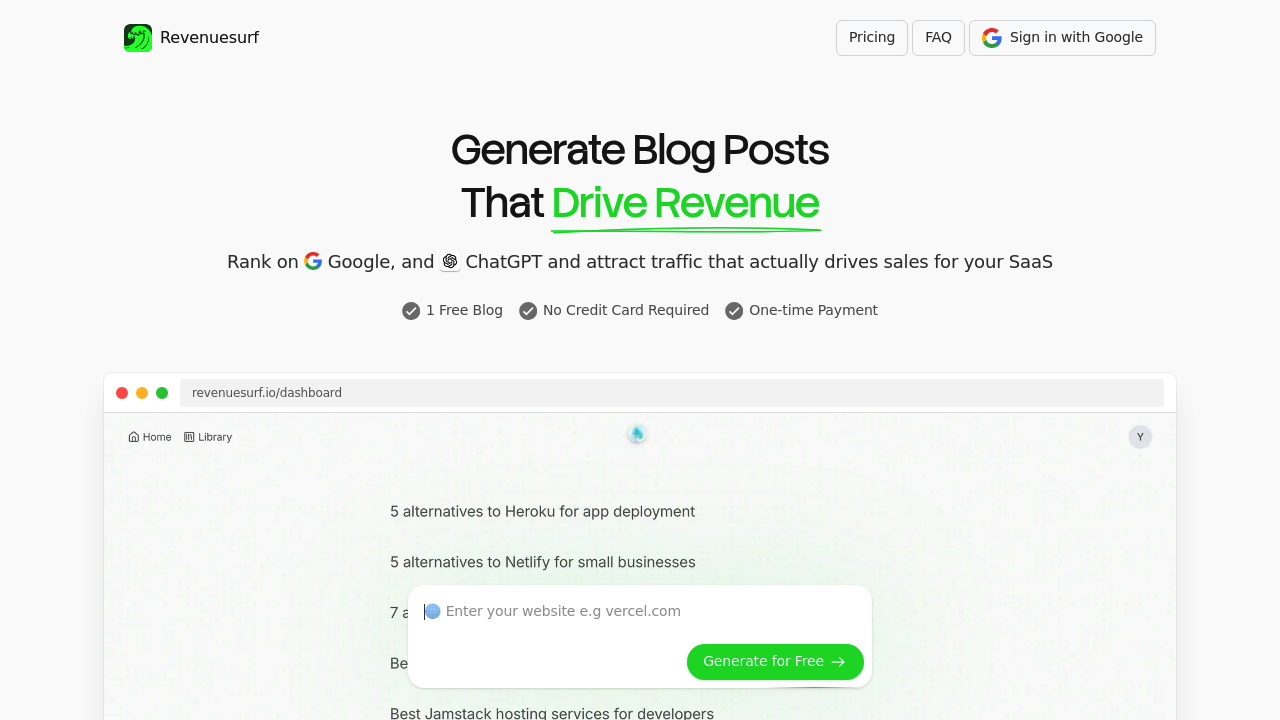
Revenuesurf generates blog posts that rank on search engines and convert readers into paying customers for B2B SaaS companies. It focuses specifically on solution-aware content, meaning articles that address problems your product solves rather than generic informational content. This approach targets prospects already looking for solutions, not just information.
The system starts with competitor research. You can build a library of competing companies and analyze their content strategies. This feeds into the keyword research pipeline, which pulls SEO data including search volume and difficulty metrics. The Google Search Console integration brings in your existing performance data, showing which queries already drive traffic to your site.
Content generation runs through a template based on proven B2B SaaS approaches. It does not operate on autopilot. You'll need to apply research and intuition to select the right topics and angles. This manual intervention requirement differentiates it from bulk content generators that pump out 30 articles per month with minimal human input.
The system emphasizes quality over quantity. Rather than flooding your blog with mediocre posts optimized for vanity metrics like domain rating, it aims to produce fewer pieces that actually generate revenue. The founder built this as an internal tool for Promptmonitor, where it successfully drove traffic and converted visitors into paying customers. Promptmonitor published 11 solution-aware articles and started seeing results from mid-August through November 2025.
The technical architecture uses a bring your own key model on paid plans. You connect your OpenRouter API credentials, which means you pay for the actual API usage separately from the Revenuesurf platform fee. This keeps your platform cost low but adds a variable expense based on how much content you generate. The free plan doesn't require an API key, so you can test the system without external accounts.
Data flows through Google Search Console to identify existing ranking opportunities and traffic patterns. The competitor research module analyzes how similar companies structure their content and which keywords they target. The keyword data layer adds search volume and difficulty scores to help prioritize topics. All this feeds into the generation template, which structures articles to address solution-aware queries.
The free plan includes one project and one content generation. You get full access to competitor research, the library feature, Google Search Console integration, and SEO keyword data. The Growth plan costs 99 dollars as a one-time payment, normally 199 dollars with a 50 percent Black Friday discount. It supports one project with unlimited content generation. The Max plan runs 149 dollars one-time, normally 299 dollars, and removes the project limit. Both paid tiers include the bring your own key feature and lifetime access. Most users pick Growth.
Technical limitations matter here. The free tier caps you at one project and one piece of content. Growth maintains the single project restriction. You can't set this up and walk away. The system requires ongoing research and decision-making about which topics to pursue. On paid plans, you're responsible for OpenRouter API costs on top of your platform fee, so your total expense varies with usage volume.
The one-time payment model differs from typical SaaS subscriptions. You pay once and keep access without recurring charges, though API usage remains a separate variable cost.