
Parliant.AI logo

Parliant.AI

A product manager launches a customer satisfaction survey after a feature update

35 views
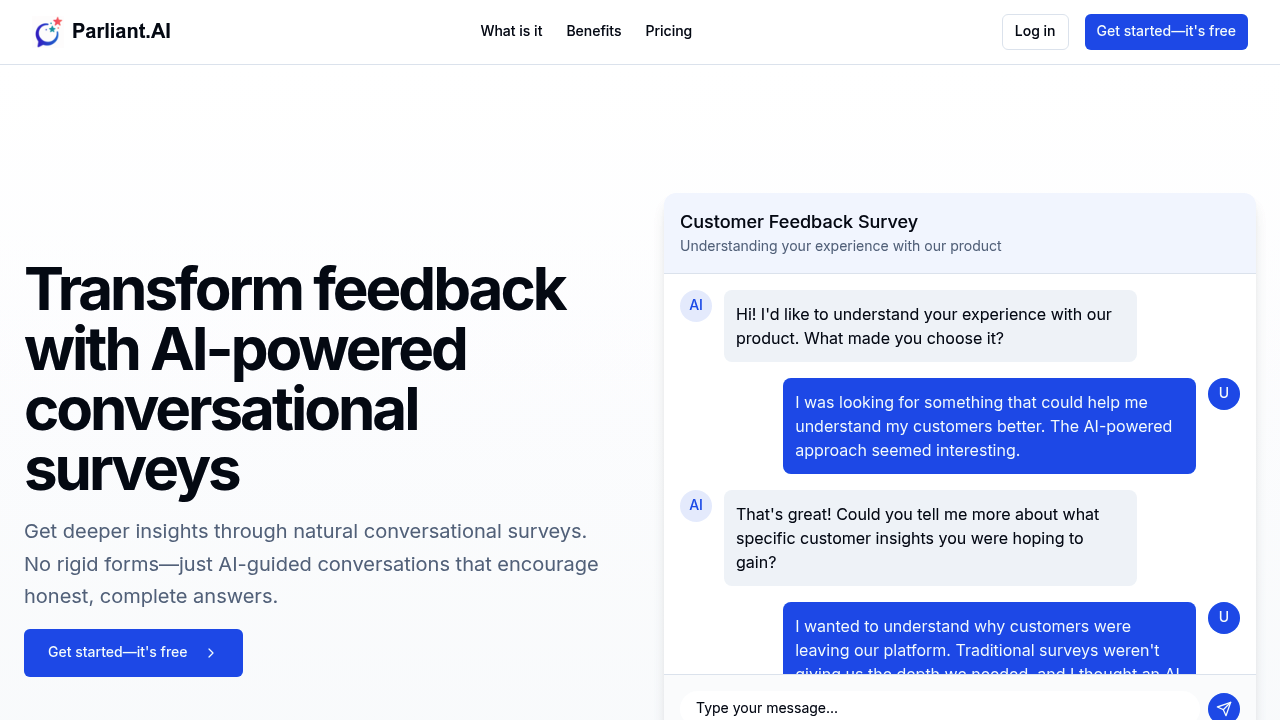
Parliant.AI screenshot

A product manager launches a customer satisfaction survey after a feature update. She gets 200 responses, mostly rating scales and one-word answers. She can see 73% are satisfied but has no idea why the other 27% aren't. The data doesn't explain what's actually broken or what users want changed. She needs conversations, not checkboxes.

Parliant.AI replaces rigid survey forms with AI-powered conversations that adapt in real-time. Instead of asking predetermined questions in fixed order, it responds to what people actually say. A user mentions they're confused by navigation, and the AI immediately asks which specific parts cause problems. Another user says they love the new dashboard, and the AI digs into what makes it work for them. The conversations feel natural because the AI writes intelligent follow-up questions based on each response.

You describe what insights you need in plain language, and the AI builds the entire conversation flow. No scripting required. Respondents can type their answers or speak them aloud, whichever feels easier. Parliant.AI automatically categorizes responses and identifies recurring themes across hundreds of conversations. Instead of reading through individual answers manually, you get extracted insights showing patterns in what customers actually care about.

The system evaluates how insightful each response is and can prompt users to elaborate when answers are too vague. Someone writes "it's fine" and the AI recognizes that's not useful feedback, asking them to explain what specifically works or doesn't work. This pushes past surface-level reactions into actual reasoning.

A UX researcher testing a new checkout flow gets detailed explanations of where users hesitate and why. An HR director gathering employee feedback about remote work policies hears concerns that wouldn't surface in multiple choice questions. A nonprofit director understanding donor motivations discovers reasons people give that weren't on her radar.

Parliant.AI works best for qualitative research where understanding the "why" matters more than counting responses. It doesn't replace quantitative surveys tracking metrics over time. You won't get statistical significance with 100 responses per month on the free plan. If you need thousands of responses for market research or demographic analysis, you'll hit limits quickly.

The free plan caps at 3 surveys and 100 responses monthly, enough to test the approach but not run ongoing feedback programs. Pro at $49 monthly includes unlimited surveys and 1,000 responses, suitable for small teams doing regular customer research. Custom branding only appears in Enterprise pricing, so free and Pro users send surveys with Parliant.AI visible.

There aren't integrations listed. You can't automatically push survey results into your CRM or analytics tools. You're working within Parliant.AI itself.

Skip this if you need simple yes/no data collection or want to survey large audiences cheaply. Also wrong if you're collecting structured data for reports where you need identical questions asked identically every time. Traditional tools handle that better.

Works when you're stuck interpreting why customers behave certain ways and multiple choice questions keep missing the real answer. When you're reading survey results thinking "but I still don't understand what they mean." When you'd interview people one-on-one if you had time but don't. It automates that conversational depth.

Frequently asked

6 questions
Can Parliant.AI ask different follow-up questions based on what people say?
A customer experience manager sends out a product feedback survey. One respondent mentions the mobile app crashes during checkout, and Parliant.AI immediately asks which device they're using and what happens right before the crash. Another respondent says they love the app, and the AI shifts to asking what specific features they use most. The conversation adapts to each person's answers instead of forcing everyone through identical questions. A market researcher testing messaging concepts gets detailed explanations from some users and brief reactions from others, with the AI probing deeper only where responses seem surface-level.
Does Parliant.AI have a free plan or free trial?
Parliant.AI offers a free plan permanently, not a trial that expires. The free version includes up to 3 surveys and 100 responses per month with basic analytics. A startup founder testing initial customer feedback could run three different conversation flows and collect 100 total responses without paying anything. There's no trial period for paid plans. Upgrading to Pro at $49 monthly gets unlimited surveys and 1,000 responses per month. The free plan works for occasional research but won't support ongoing feedback programs that need hundreds of responses weekly.
What's the response limit on the Pro plan?
Pro plan caps at 1,000 responses per month for $49. A small SaaS company doing quarterly customer check-ins could survey 250 users four times a year and stay within limits. A UX team running two research projects monthly with 400 responses each would hit the ceiling. The limit counts total responses across all surveys combined, not per survey. A nonprofit collecting donor feedback from 1,200 people would need Enterprise pricing. The 1,000 response cap suits teams doing regular qualitative research but not mass audience surveys or continuous feedback collection from large customer bases.
Can Parliant.AI connect to Salesforce or Google Sheets?
There aren't any integrations listed for Parliant.AI. A sales team wanting survey insights automatically pushed into Salesforce records would need to export and import manually. A product manager who tracks all research in Google Sheets can't set up automatic data flow. The tool works as a standalone platform where you review responses and extract insights within Parliant.AI itself. An HR director gathering employee feedback would copy key themes into their existing reporting systems rather than connecting them directly. Teams relying on automated workflows between tools will find this creates extra manual work.
When should you use regular surveys instead of Parliant.AI?
A regional manager tracking weekly employee satisfaction scores across 50 locations needs identical questions asked the same way every time for comparison. Regular surveys handle that better. A political campaign polling 10,000 voters on specific policy positions needs quantitative data and statistical significance that Parliant.AI's response limits won't support. An e-commerce company measuring Net Promoter Score monthly wants simple numerical tracking, not conversational depth. Parliant.AI works when you're stuck interpreting why customers do things and need detailed explanations, not when you're counting responses or need structured data for charts and trend analysis.
What happens if someone gives a vague answer in Parliant.AI?
A hotel chain surveys guests about their stay. Someone types "it was fine" and Parliant.AI recognizes that's not useful feedback. The system evaluates insight level and prompts the person to explain what specifically worked or didn't work about their room, service, or amenities. Another guest writes a detailed paragraph about slow check-in and rude desk staff, and the AI accepts that as sufficient. A product manager testing a new feature gets past surface reactions because the system pushes users to elaborate on vague statements. This evaluation system prevents the shallow responses that make traditional survey results unhelpful.

Traffic

Estimated monthly website visits · last 0 months

Not enough historical data for a chart yet.

Data from SimilarWeb · Updated monthly.

Reviews (0)

Write review

No reviews yet. Be the first to share your experience.

Similar tools

See all →