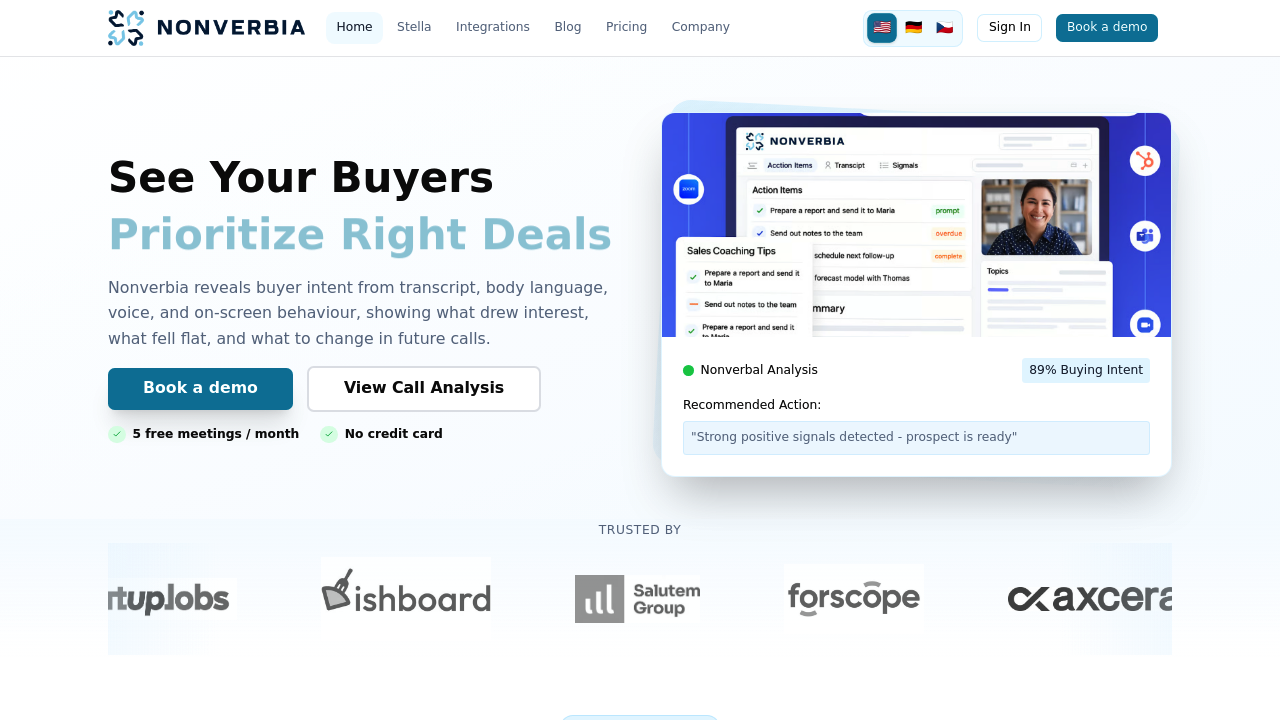
Sales teams lose deals because they miss buying signals hidden in tone shifts, fleeting facial expressions, and subtle body language cues that traditional call recording cannot catch. Nonverbia, marketed under the name Stella, records sales calls and dissects them through multiple analytical lenses simultaneously. The system examines transcripts for content, tracks micro-expressions like nods and eye contact patterns, analyzes voice characteristics including hesitation and pacing, and monitors on-screen behavior to paint a complete picture of buyer intent and seller performance.
The body language analysis goes beyond simple engagement tracking. Stella identifies specific facial reactions during key moments, measures eye contact duration, and flags non-verbal agreement signals that indicate buying readiness. Voice analysis captures confidence levels, detects hesitation patterns, and evaluates speaking pace to reveal emotional undercurrents that words alone don't convey. These inputs feed into AI-generated sales scores that quantify both buying readiness and presenter skill, with the system claiming 89% accuracy in detecting buying intent and voice pattern recognition exceeding 85%.
Coaching insights address common sales pitfalls by tracking pacing issues, interruption frequency, and filler word usage. The Formula Bar Self-Review feature gives individual contributors access to their own performance statistics for self-improvement. Manager Mode switches the view to team-level analytics with comparative dashboards showing how different reps perform across the same metrics. Professional presence analysis evaluates outfit choices, background setup, and technical quality, factors that influence buyer perception before anyone speaks.
The system generates deal-winning action plans by identifying risks and opportunities within each conversation. Smart stakeholder mapping builds org charts and influence diagrams automatically, helping sellers manage complex buying committees. Custom prompts let users create personalized analysis fields tailored to their sales methodology or industry-specific needs. CRM systems receive automatic updates, and email plus Slack connectors distribute insights where teams already work. The company claims users save 14 hours weekly on administrative tasks and see close rates increase by 30%.
The free plan provides 120 minutes monthly, covering roughly two to four calls depending on length. This tier includes recording, transcription, summaries, body language analysis, tone evaluation, and coaching insights, but delivers only generic AI sales scores and generic next steps. Professional presence analysis isn't available. The $19 monthly Pro plan removes meeting limits and upgrades to tailored sales scores and next steps while adding professional presence checks and tailored sales context. Business tier at $49 monthly adds CRM integrations, custom prompts, manager dashboards, team comparison tools, and email plus Slack connectors. Enterprise pricing remains custom, bringing custom integrations, data migration support, SSO, security governance, and dedicated support.
Free and Pro users can't access CRM integrations or manager features. Custom prompts only become available at the Business level. Security features like SSO and governance controls require Enterprise contracts. The software positions itself against traditional sales development, which demands mastery of 47-plus skills over five to ten years of practice. Stella delivers comparable analysis instantly with zero training investment.
Nonverbia reached finalist status for AI Rising Star of the Year in the Enterprise category, competing among 82 shortlisted companies. The recognition highlights its approach to reading nonverbal communication in business contexts, an area sales technology historically ignored while focusing purely on what people say rather than how they say it.