
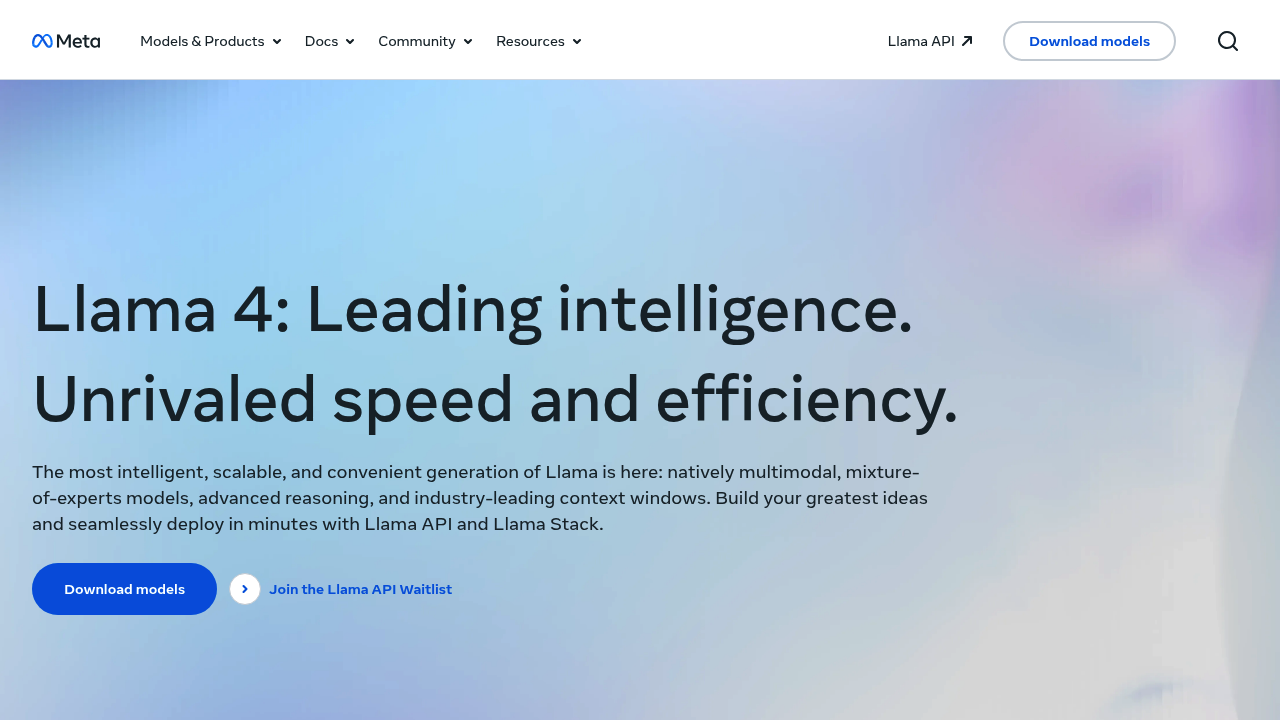
Meta's Llama fuses text and vision data during pre-training. Not bolted together afterward. This early fusion creates genuine multimodal intelligence instead of typical patchwork solutions.
Models range from 1B to 405B parameters. The 10M-token context window handles massive documents and conversations that break other models. A machine learning engineer building document analysis systems can process entire legal contracts or research papers. No chunking required.
Llama runs efficiently on a single H100 GPU even at larger sizes. Fine-tuning and distillation let you customize models for specific tasks. Quantization reduces computational requirements when working with limited resources.
Completely open-source. No pricing tiers. No API limits.
This works well for startup CTOs who need custom AI deployment without recurring costs eating runway. You can fine-tune the 8B model for customer support — deploy it on your own infrastructure and never worry about per-token charges scaling with usage.
Recent versions include Llama 4, 3.3, 3.2, and 3.1 with multilingual capabilities spanning dozens of languages. Vision capabilities handle image and text reasoning tasks. The 405B model delivers performance rivaling proprietary alternatives at a fraction of operational cost, though you'll need serious hardware to run the largest variants effectively.