
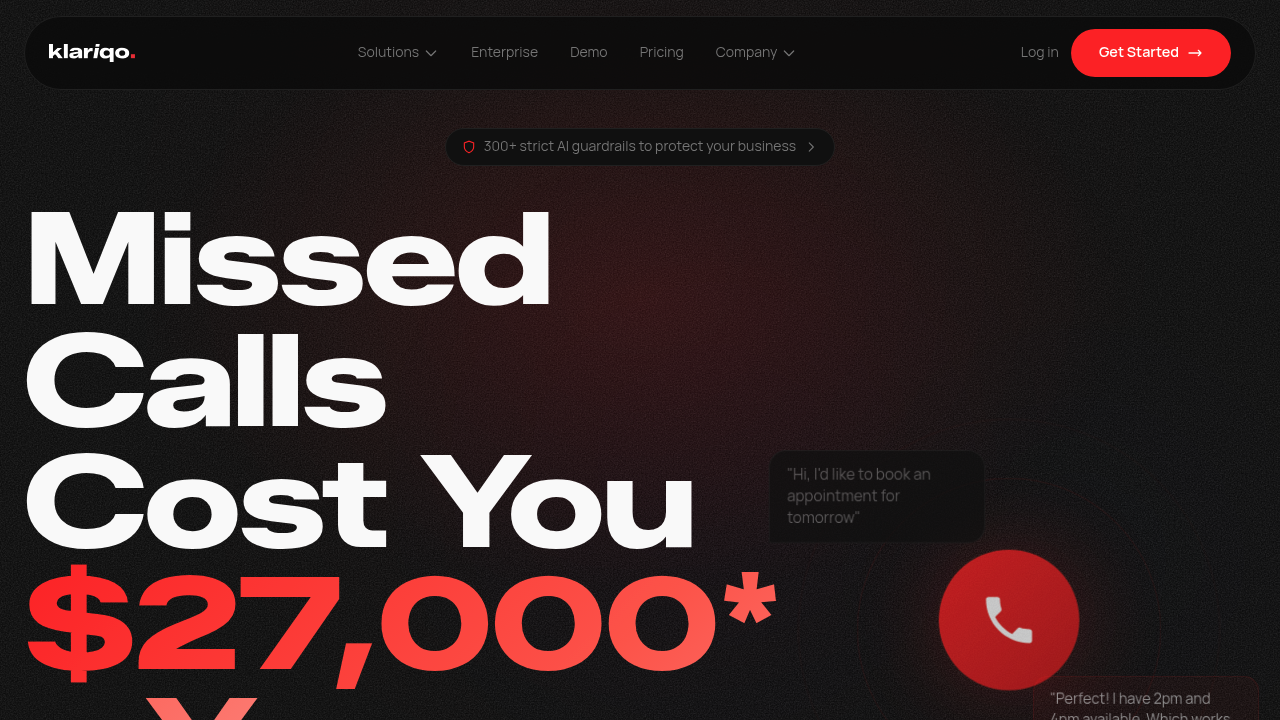
Klariqo handles incoming phone calls for businesses using AI voice technology that responds in 0.4 seconds. The system picks up immediately when someone calls, processes what they're saying in real-time, and replies using a voice engine that can handle interruptions and natural speech patterns the way humans do. It's built to sound like a person at a desk, complete with background office noise like keyboard clicks and ambient chatter to create the impression of a busy office environment.
The data pipeline works through a knowledge base that businesses populate during setup. When a call comes in, the system listens to the caller's question or request, searches its knowledge base for relevant information, and formulates a response. For appointment booking, it connects to calendar systems and scheduling tools to check availability and confirm times. The voice engine processes speech continuously rather than waiting for pauses, which is how it handles interruptions without breaking the conversation flow. It also stores information about repeat callers so it can greet them by name on subsequent calls.
Call handling happens concurrently without limits. Multiple people can call simultaneously and each gets an immediate answer. The system records and transcribes every conversation, which businesses can access later through a dashboard. This recording feature is specifically built for dispute resolution, letting businesses play back exactly what was said during a call. Lead scoring runs automatically on incoming calls, categorizing them based on predefined business criteria.
The voice recognition handles various English accents including American, British, Australian, and Indian dialects. It filters out background noise from the caller's end to focus on speech. When the AI encounters a question it can't answer from its knowledge base, it transfers to a human operator along with the full conversation context so the person doesn't need to repeat themselves.
Integration happens through direct connections to field service management platforms. It connects to Jobber, Housecall Pro, and ServiceTitan, plus over 50 CRM systems. When appointments are booked, they sync automatically to these platforms. For service businesses, it can dispatch SMS notifications when new jobs come in. The setup process is no-code and takes three minutes according to their specifications.
The system includes 300 AI guardrails that prevent the assistant from making commitments the business can't keep or sharing information it shouldn't. These are rule-based constraints that override the natural language processing when necessary. The dashboard shows business-specific metrics rather than generic call data, customized to what each industry cares about.
Response latency sits at 0.4 seconds from when the caller stops speaking to when the AI starts replying. That's faster than human reaction time. The system has handled over 11,000 calls based on their reported numbers.
Pricing starts at $99 per month. That covers the full system including unlimited concurrent calls, recording, transcription, and CRM integrations.
The primary limitation is language support. It currently works only in English, with multi-language support planned but not available. Complex or unexpected questions still require human transfer. The AI can't improvise outside its knowledge base, so businesses need to keep that information current and thorough. If the knowledge base has gaps, callers get transferred to humans more frequently.