
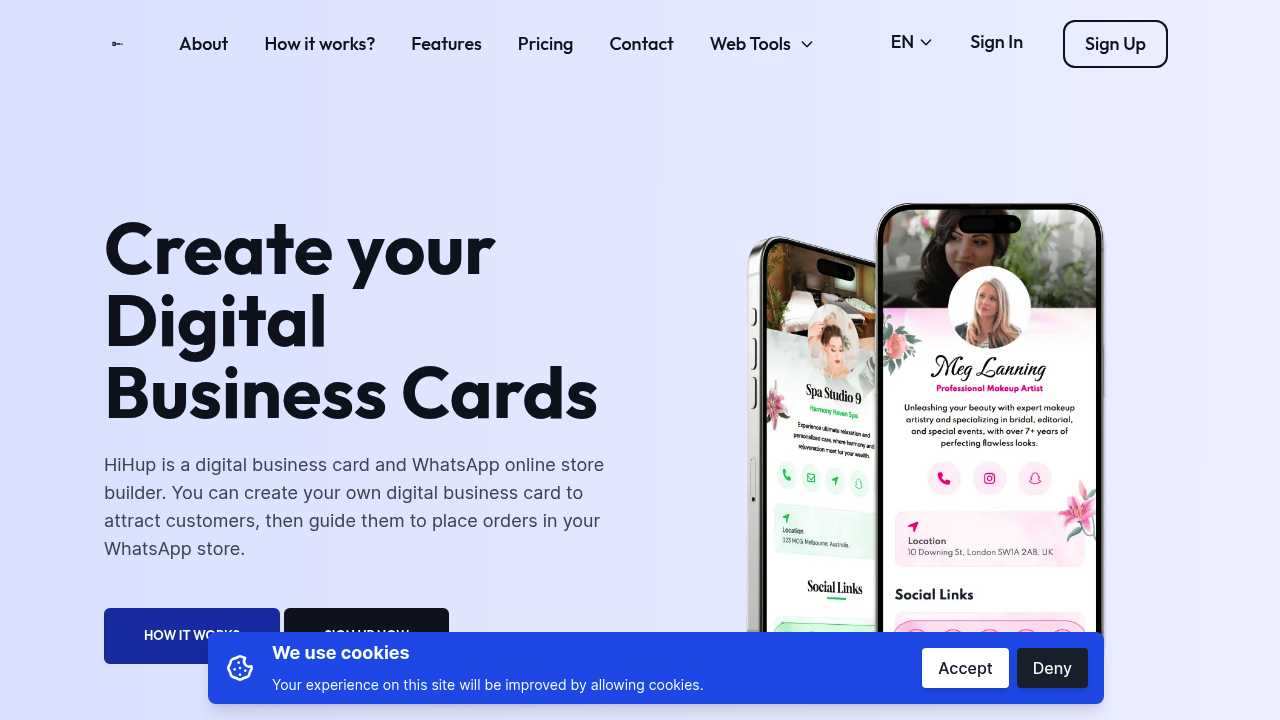
HiHup combines digital business cards with WhatsApp store functionality in a single system. The service generates personalized URLs that host both contact information and product catalogs, designed specifically for businesses that use WhatsApp as their primary sales channel.
The technical architecture centers on a hosted card builder that outputs responsive web pages. Users input contact details, product listings, service descriptions, and payment information through a web interface. The system then generates a unique URL that displays all this information in a mobile-optimized format. Each card supports vCard export, meaning visitors can download contact information directly to their phone's address book in standardized format.
The WhatsApp integration works through pre-filled conversation links. When a visitor clicks on a product or service, the system constructs a WhatsApp URL with pre-populated message text about that specific item. This opens the user's WhatsApp application with a conversation already started, reducing friction in the ordering process. It's a straightforward implementation that doesn't require API access to WhatsApp itself.
Storage architecture varies by tier. The free plan allocates 100MB for images and media, while the Appetizer plan provides 500MB. The Main Course plan offers unlimited storage. All media gets hosted on HiHup's servers and loads through their content delivery system, which they claim optimizes for faster page loading compared to self-hosted alternatives.
The service includes Progressive Web App functionality on paid tiers. This means the digital card can be installed to a phone's home screen and behaves like a native application, with offline caching and app-like navigation. The PWA implementation doesn't require app store distribution.
Google Maps integration embeds location data directly into cards. YouTube links display video content inline. Google Wallets integration lets businesses to generate digital loyalty cards or passes that customers can add to their Google Wallet app, though this feature caps at 50 passes on the Appetizer plan and goes unlimited on Main Course.
The contact form captures enquiries directly through the card. Free accounts get 10 enquiries before hitting their limit. Appetizer accounts get 100. Main Course removes this constraint entirely. Forms don't integrate with external CRM systems based on the provided specifications.
Custom domain support exists on paid plans, allowing businesses to serve their digital card from their own domain name rather than a HiHup subdomain. This requires DNS configuration on the user's end. Password protection adds an authentication layer before visitors can view card contents.
NFC card ordering is available on paid tiers. These are physical cards with embedded NFC chips that, when tapped against a phone, direct to the digital card URL. HiHup handles ordering but doesn't manufacture the cards themselves.
The free plan allows one vCard and one store with five items each for services, products, links, payment methods, galleries, and testimonials. It's limited to two categories for organizing content. The Appetizer plan bumps this to five vCards and stores with expanded item limits. Main Course removes most numerical restrictions entirely.
Branding removal only works on paid accounts. Free users display HiHup attribution on their cards. The service doesn't offer white-label options for agencies or resellers based on available information.
The system doesn't support team collaboration features or multi-user access to a single account. Each vCard appears to be managed individually by whoever creates it. There's no API access mentioned for external integrations or automation workflows.
Pricing starts at $19.90 monthly for the Appetizer plan and $29.90 monthly for Main Course. The free tier remains available indefinitely without requiring credit card information.