
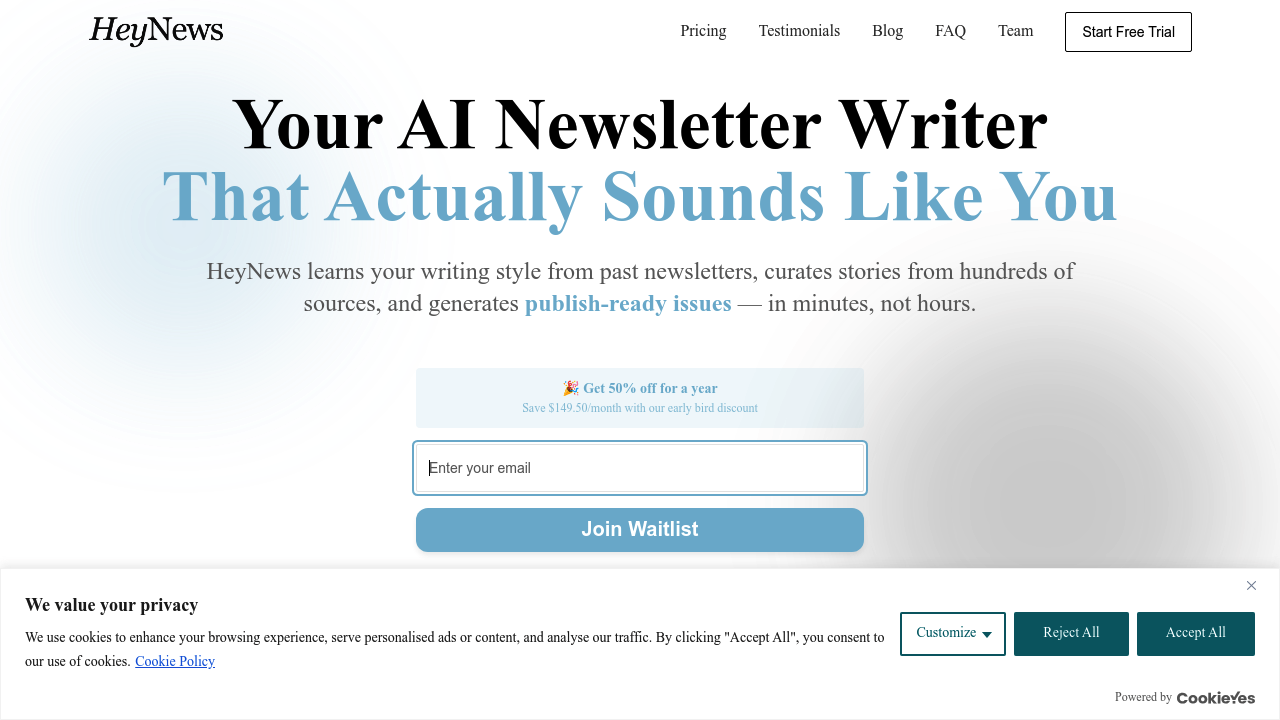
Newsletter creators spend hours each week hunting for content, drafting issues, and trying to maintain consistency. HeyNews attacks this problem by training an AI on your actual past newsletters, then using that learned voice to generate complete newsletter drafts in minutes.
The voice training process sits at the core of what makes this service different from generic AI writing assistants. You connect your existing newsletter, and the system analyzes your previous issues to identify your tone, writing patterns, signature phrases, and topic preferences. It's not trying to write like a generic newsletter writer. It's trying to write like you. The voice profile continues improving with every issue you publish, creating a feedback loop that makes the AI's output more accurate over time. One user reported cutting their daily newsletter production time from one hour down to five minutes while maintaining their distinctive style.
Content curation runs automatically in the background. The system monitors hundreds of sources every four hours, pulling in relevant articles, news, and updates based on your topic preferences. You can add RSS feeds and custom URLs to expand what the AI watches. This means you're not just getting AI-generated text based on stale training data. You're getting drafts built around current content from sources you actually care about.
When you're ready to create an issue, the one-click generation produces a full draft organized into sections. The rich editor lets you refine each section individually, adjusting tone or length without rewriting from scratch. You can add your own commentary to specific items or completely rework sections that miss the mark. The editing interface gives you control without forcing you back into a blank page scenario.
Performance tracking shows open rates, click rates, and engagement metrics so you can see what connects with your audience. This data presumably feeds back into the AI's understanding of what works, though the specifics of that connection aren't detailed.
Right now, Beehiiv is the only newsletter platform with direct integration. Connection takes about five minutes, and you can generate your first AI-assisted issue in under five minutes after that. Kit, Mailchimp, and Buttondown integrations are marked as coming soon, which means anyone using those platforms can't use HeyNews yet. That's a significant limitation given how many newsletter creators use those services. The RSS and URL monitoring works regardless of platform, but you'd need to manually transfer content to your newsletter software until your specific integration arrives.
The network has reached over 350,000 subscribers across users, which suggests meaningful adoption among newsletter publishers. That number does not tell you how many individual creators use the service, just the combined reach of their audiences.
Newsletter creators who publish frequently get the most value here. Daily or weekly publishers who feel the grind of constant content curation and drafting can reclaim substantial time. The service assumes you already have a newsletter with past issues to train on. New newsletter creators without an established voice and archive wouldn't benefit from the personalized training feature that makes HeyNews distinct.
HeyNews works best for curated newsletters that aggregate and comment on existing content rather than original reporting or deep analysis pieces. If your newsletter relies on unique research, interviews, or proprietary insights, an AI can't replicate that source material. It can only help with the writing and curation components.