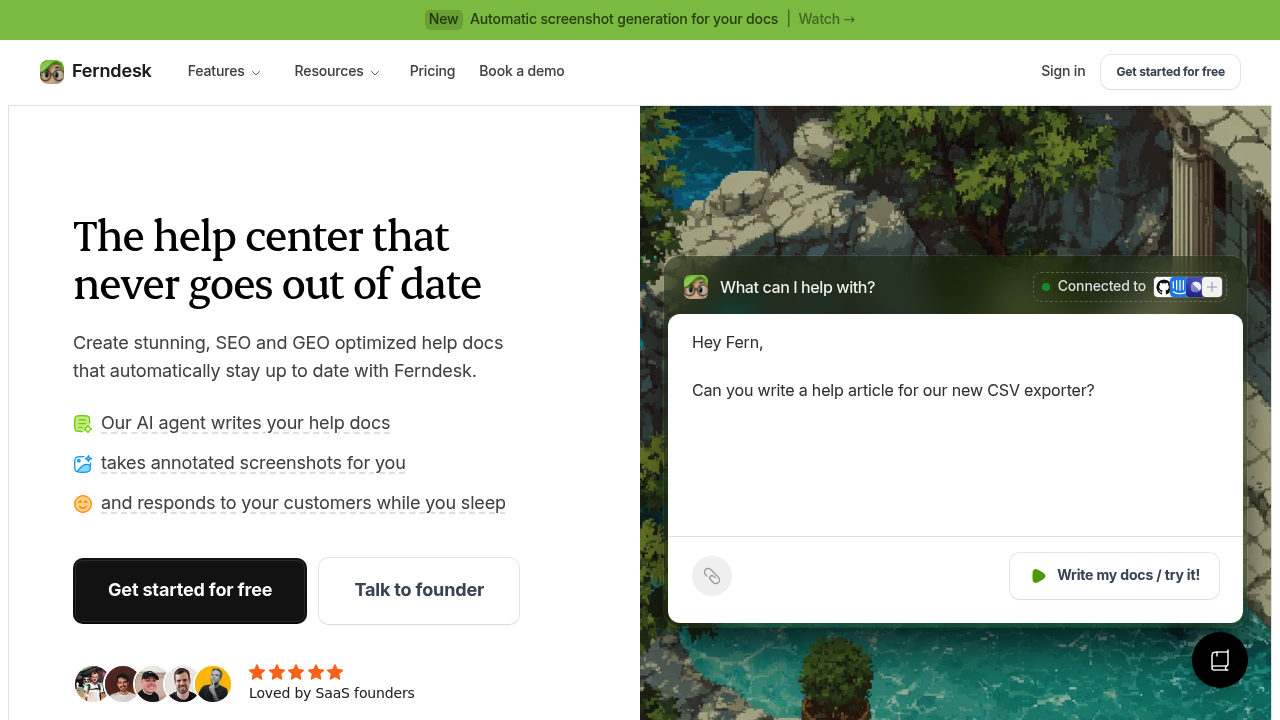
Documentation becomes outdated the moment you publish it. Ferndesk tackles that problem by turning help center maintenance into an automated process. An AI agent named Fern reads your codebase, support tickets, changelogs, and product videos to write and update documentation without human intervention.
The system watches your product for changes. When your code shifts or features evolve, Fern drafts new articles or updates existing ones. It takes fresh screenshots automatically so your visuals don't show last year's interface. You still review and approve changes before they go live, but the heavy lifting happens behind the scenes.
The system embeds directly into your product as a self-service widget. Customers search for answers without leaving your app. Fern also powers a help desk chatbot that pulls from your knowledge base. A Chrome extension lets you update docs from any browser tab, which speeds up those quick edits when you're not in the main dashboard.
Code-to-docs synchronization means technical documentation stays aligned with your actual codebase. This matters for API docs and developer guides where accuracy determines whether users can implement your product. The system handles multilingual translation and optimizes content for search engines and AI engines that increasingly power discovery.
You can run internal knowledge bases with login requirements alongside public-facing help centers. Custom domain or subfolder hosting keeps everything on-brand. Pages load in milliseconds, which helps when customers are frustrated and need answers fast.
Does it actually save time? According to usage data, customers save 20 hours monthly on average. That's roughly half a work week that would otherwise go toward rewriting outdated articles and chasing down screenshots.
The Startup plan at $39 monthly limits you to 2 collaborators and 2 languages. Small teams hit those caps quickly. The Team plan at $99 monthly bumps you to 5 collaborators and 5 languages with unlimited AI answers and publishing. Still, five people might not cut it for growing support teams. Enterprise pricing is custom and provides unlimited team members plus white-glove onboarding.
The 7-day trial gives you time to test whether the AI understands your product well enough to generate useful content. That's the real test. Generic AI writing tools exist everywhere, but context-aware documentation requires the system to actually comprehend what your product does and how it's changing.
The review workflow is non-negotiable. You'd be reckless to let AI publish documentation without human oversight. Mistakes in help docs create support tickets instead of preventing them. This means you're not eliminating work entirely — you're shifting from writing to editing and approving.
Solo founders and product-led companies get the most immediate value. If documentation slips because you're shipping features faster than you can document them, automation closes that gap. Teams scaling self-service support benefit when article volume makes manual updates impractical.
The 10+ integrations connect your existing tools, though the specifics aren't listed. Enterprise customers can request custom integrations if their stack includes unusual systems.
This works best when your product changes frequently enough that documentation maintenance becomes a recurring pain point. If your product is stable and rarely updates, you might not need automated syncing. But for fast-moving teams where help docs lag behind reality, Ferndesk converts a perpetual problem into a managed workflow.