
DiffScout logo

DiffScout

Competitor price monitoring typically calls for uploading product catalogs, matching SKUs across platforms, and waiting for engineering resources to set up integrations

30 views
DiffScout screenshot

Competitor price monitoring typically calls for uploading product catalogs, matching SKUs across platforms, and waiting for engineering resources to set up integrations. DiffScout strips all that away. You paste a competitor's URL, and it starts tracking that exact page for price changes. No catalog uploads. No SKU matching. No developer needed.

The system works across Shopify storefronts, Amazon listings, brand websites, and marketplaces. It handles JavaScript-rendered pages and sites with bot protection, extracting prices automatically regardless of how the page loads or what anti-scraping measures exist. When a competitor changes their price, DiffScout sends an email alert within 60 minutes. The median time to alert after a competitor moves sits at 1.8 hours, which the company positions as 91% faster than manual monitoring.

Price history gets stored with screenshots showing exactly what the competitor's page looked like at each check. DiffScout assigns diff and impact scores to changes, letting you prioritize which shifts matter most. Custom alert thresholds mean you can filter out noise and only get notified when changes cross your defined boundaries.

Setup takes about 30 minutes according to the company's data. Zero engineers required.

The free plan monitors one competitor page with five total price checks and keeps seven days of history. That's extremely limited but enough to test whether DiffScout extracts prices correctly from your specific competitor sites. The Starter plan at $29 monthly bumps you to four competitor pages and 120 checks per month with 30 days of history. Pro at $49 monthly covers 50 pages and 200 checks with 90 days of history plus priority support. Business at $99 monthly removes page limits but caps you at 450 checks monthly, adds full price history, enables checks as frequent as every 30 minutes, and includes webhook and API access for piping alerts into your own systems.

Those check limits create real constraints. Missions pause automatically when you hit your monthly limit, meaning you need to calculate how often you want to check each competitor URL. If you're monitoring 50 pages on the Pro plan with 200 checks, you can only check each page four times monthly. The Business plan's unlimited pages sound generous until you realize 450 checks spread across many pages means infrequent monitoring per page.

D2C teams and retail brands represent the core audience. Fashion brands tracking competitor seasonal pricing. Store owners watching marketplace competitors undercut them. DiffScout positions itself against Visualping, which detects changes but doesn't parse prices specifically. Against Prisync and Price2Spy, which require catalog uploads and matching. Against Wiser, which costs more and targets enterprise buyers with IT departments.

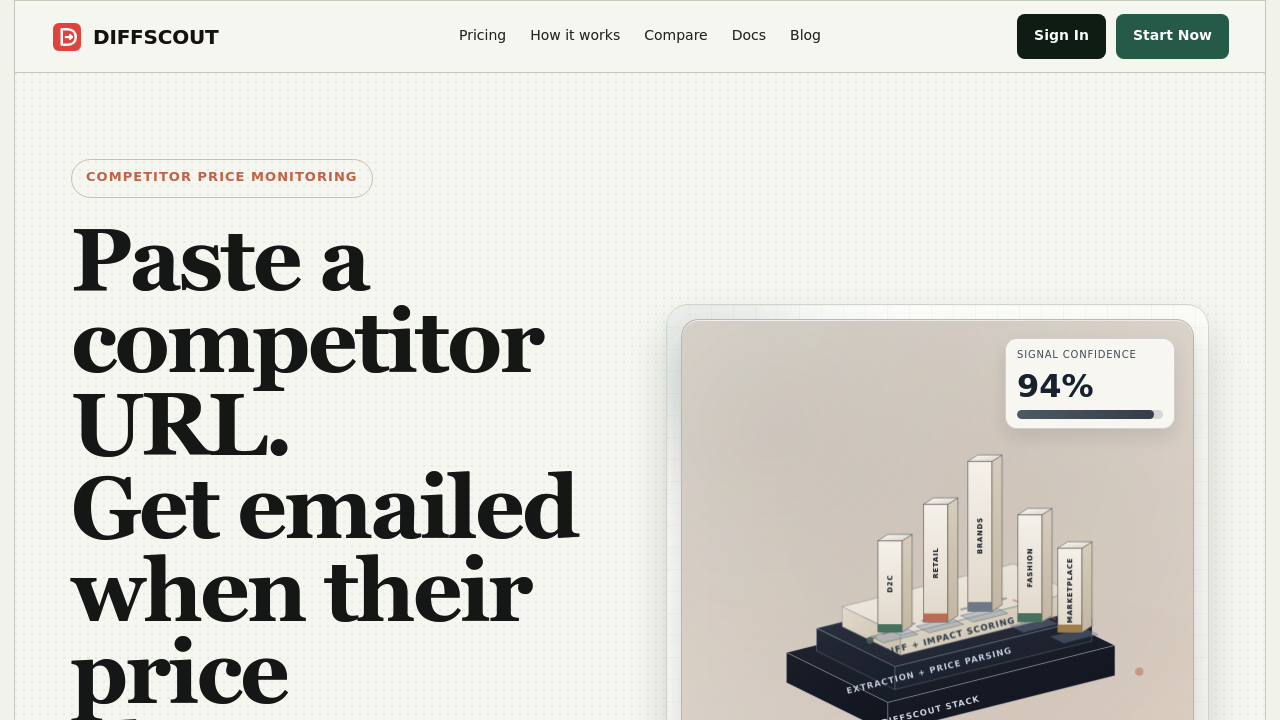
Signal confidence sits at 94%. DiffScout can be live in 30 minutes. That speed matters when a competitor drops prices and you need to know immediately whether to match, ignore, or adjust your own strategy. The webhook and API access on the Business plan lets you automate responses, feeding price changes directly into repricing systems or alerting Slack channels.

The single-URL approach works brilliantly for small competitor sets but doesn't scale well for tracking hundreds of products across dozens of competitors. You're monitoring pages, not products, which means if a competitor sells the same item on multiple pages or platforms, you need separate missions for each URL.

Frequently asked

7 questions
How fast does DiffScout detect competitor price changes?
DiffScout sends email alerts within 60 minutes when a competitor changes their price, with a median alert time of 1.8 hours after the competitor makes the move. The company claims this is 91% faster than manual monitoring methods. On the Business plan at $99 monthly, you can set checks to run every 30 minutes for near-real-time tracking. Lower-tier plans use daily or weekly check frequencies, so your detection speed depends on how you allocate your monthly check quota across the competitor pages you're monitoring.
Does DiffScout have a free plan?
DiffScout offers a free plan that monitors one competitor page with five total price checks and seven days of price history. That's extremely limited but enough to test whether the tool correctly extracts prices from your specific competitor sites before paying. There's no free trial of the paid plans, so the free tier serves as your testing ground. Paid plans start at $29 monthly for the Starter tier, which gives you four competitor pages and 120 checks per month with 30 days of history.
How many competitor pages can you monitor with DiffScout?
The free plan monitors one page, Starter at $29 monthly handles four pages, Pro at $49 monthly covers 50 pages, and Business at $99 monthly offers unlimited pages. However, monthly check limits create the real constraint. Pro gives you 200 checks monthly across those 50 pages, meaning roughly four checks per page if you monitor all 50. Business provides 450 checks monthly despite unlimited pages, so adding more competitor URLs means checking each one less frequently unless you're selective about what you track.
Can DiffScout track prices on Amazon and Shopify stores?
DiffScout monitors prices across Amazon listings, Shopify storefronts, brand websites, and marketplaces by extracting data directly from the competitor's URL. It handles JavaScript-rendered pages and sites with bot protection, parsing prices regardless of how the page loads. You paste the specific competitor product URL, and DiffScout starts tracking that exact page without requiring product catalogs or SKU matching. This works for any publicly accessible product page where prices display, though you're monitoring individual URLs rather than tracking products across multiple platforms automatically.
What happens when you run out of price checks on DiffScout?
Missions pause automatically when you hit your monthly check limit, and monitoring stops until your quota resets the next billing cycle. The Starter plan's 120 checks monthly means if you monitor four pages daily, you'll exhaust your checks in 30 days, but checking those same pages twice daily drains your quota in 15 days. The Pro plan's 200 checks across 50 pages forces you to choose between monitoring many competitors infrequently or fewer competitors more often. There's no option to purchase additional checks mid-cycle, so you need to upgrade to a higher tier if you consistently hit limits.
Does DiffScout require SKU matching or product catalog uploads?
DiffScout requires zero catalog uploads and no SKU matching, which separates it from tools like Prisync and Price2Spy that need you to map your products to competitor products. You paste a competitor's product page URL, and DiffScout extracts the price from that specific page automatically. Setup takes about 30 minutes and requires no engineers or technical resources. This single-URL approach works well for monitoring a focused set of competitor pages but means tracking the same product across multiple competitor sites or platforms requires separate monitoring missions for each URL.
What's included in DiffScout's Business plan?
The Business plan at $99 monthly provides unlimited competitor pages to monitor, 450 checks per month, full price history with no time limits, and checks as frequent as every 30 minutes. It adds webhook notifications and API access so you can pipe price change alerts directly into your own systems, Slack channels, or automated repricing tools. You also get dedicated support rather than the priority support offered on Pro. The 450 monthly checks still constrain how often you can check each page, so unlimited pages doesn't mean unlimited monitoring frequency across a massive competitor set.

Reviews (0)

No reviews yet. Be the first to share your experience.

Similar tools

See all →