
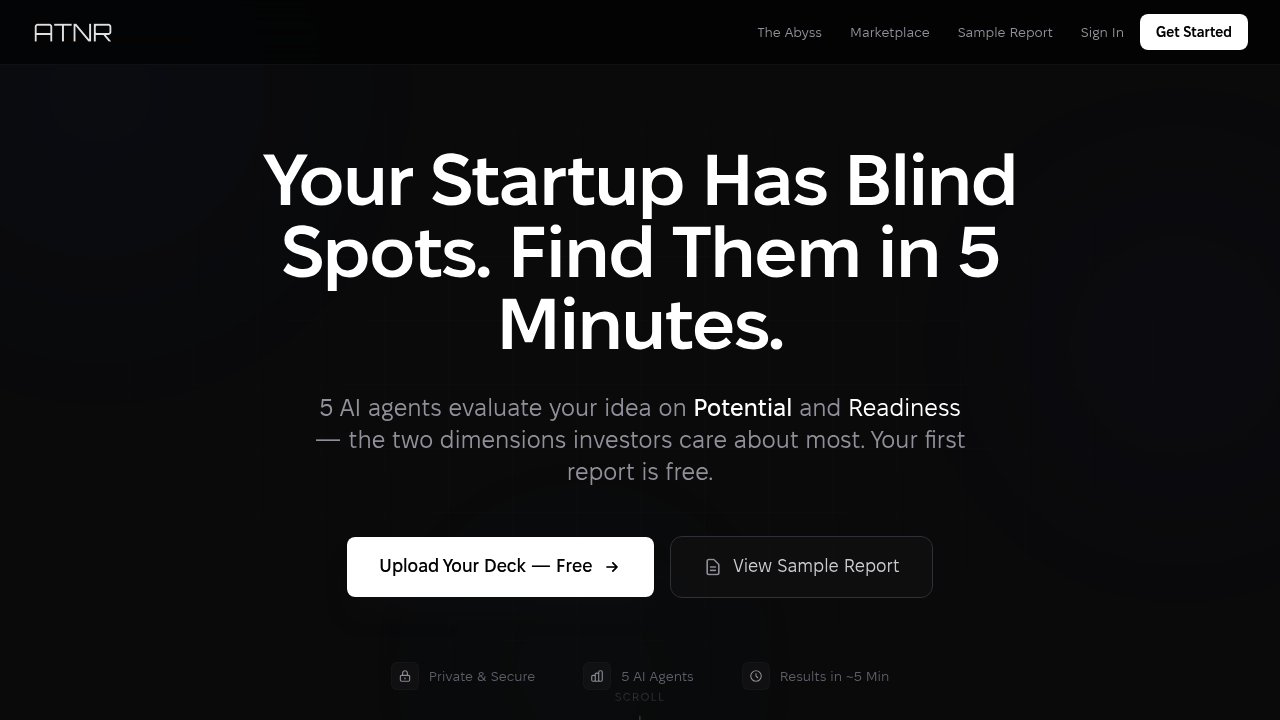
Startup founders face a brutal reality — 35% of startups fail not because their idea lacks potential, but because they aren't ready to execute. That gap costs founders an average of six months and over $40,000 in burned capital. Athanor Market addresses this by evaluating startups on two distinct axes rather than the single-dimension scoring most tools provide.
The system deploys five specialist AI agents that analyze startups in parallel, each examining different aspects of the business. What sets this apart is the adversarial debate methodology. After initial analysis, Optimist and Pessimist agents stress-test the findings against each other before the system synthesizes a final assessment. This produces two separate scores: Potential measures the market opportunity and business model viability, while Readiness evaluates whether the team and execution plan can actually deliver. Traditional evaluation tools miss that second dimension entirely, leaving founders blind to execution risks even when their concept shows promise.
Founders can submit information through pitch deck uploads or structured forms. The AI Co-Pilot, called Marcus, handles chat-based form filling through voice and text, making data entry less tedious. Results arrive in roughly five minutes for quick validations, 15 minutes for standard assessments, and 30 minutes for the deepest verification tier.
The Investor Data Room functionality targets venture capitalists and angel investors managing dealflow. Granular access controls let investors share specific sections with different stakeholders while maintaining NDA workflows. Password-protected sharing links and PDF exports enable internal discussions without exposing sensitive startup data broadly. Investors can also use the Import Pipeline to bulk-upload deal lists for batch evaluation, then track engagement analytics to see which opportunities generate the most interest among their team.
Team collaboration features include role-based permissions across four levels: Owner, Admin, Editor, and Viewer. Multiple collaborators can access the same startup evaluation, useful for co-founder teams seeking alignment or advisors providing input. Re-evaluation tracking monitors how scores change over time as founders address weaknesses, creating a measurable improvement path.
The free Quick Validation tier offers one report monthly using four agents instead of five. It generates only the Potential score, omitting Readiness analysis entirely. That three-minute filter helps founders get initial feedback without payment but won't identify execution blind spots.
The $39 Assessment includes all five agents plus the adversarial debate process, delivering both Potential and Readiness scores. This tier includes validation from the Circle of Alchemists, a community of human experts who review the AI analysis and provide additional perspective. Assessment reports take about 15 minutes to generate.
The $199 Verification tier adds deep verification using more advanced AI models, Entity Graph analysis with confidence intervals showing certainty levels for each finding, and founder KYC through a partner service. This 30-minute analysis produces investment committee-ready documentation.
The free tier's single monthly report and missing Readiness dimension limits its usefulness for serious validation. Founders testing multiple pivots or variations will hit that monthly cap quickly. Entity Graph and confidence intervals only appear in Verification, so cheaper tiers don't expose how certain the AI is about its conclusions. Quick Validation's four-agent analysis means less thorough coverage than paid tiers.
Investors conducting due diligence get structured reports faster than manual analysis, while founders gain objective feedback before pitching. The dual-axis framework catches readiness gaps that optimistic founders often overlook until they're deep into execution and struggling.