
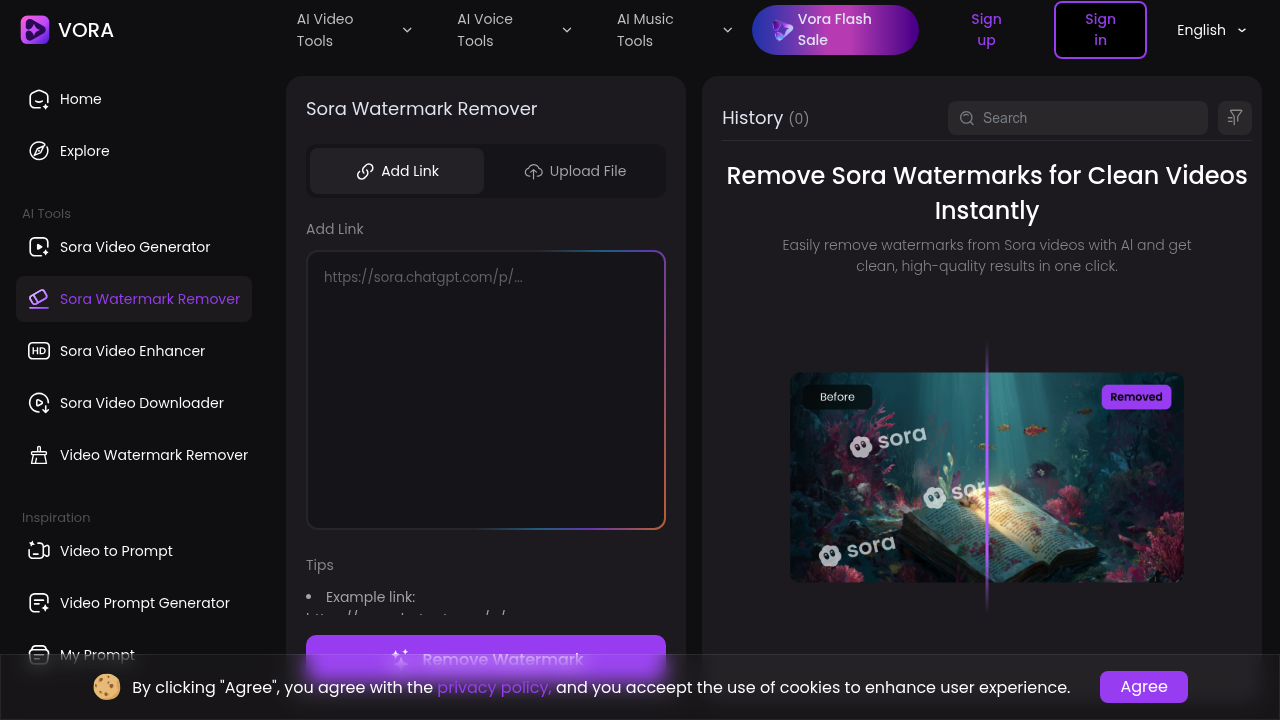
This software strips watermarks from AI-generated videos using detection and inpainting algorithms. It targets text overlays and logos embedded in video output, scanning for them automatically regardless of where they sit in the frame, how large they are, or what opacity level they're set to. The detection system doesn't require manual marking or frame-by-frame editing.
The watermark removal runs through intelligent inpainting algorithms that reconstruct the pixels underneath the watermark. This works by analyzing surrounding visual information and generating replacement content that matches the video's texture, color, and motion patterns. The process maintains frame consistency, meaning the reconstructed areas don't flicker or shift between frames, which is a common artifact in lower-quality removal tools.
Users upload videos either by pasting a direct link or by uploading the file directly. Processing happens online and typically completes in one to two minutes. The system preserves the original video specifications throughout, keeping resolution, frame rate, color space, and sharpness intact. The output quality matches the input without compression or downscaling.
This software tracks removal history so users can revisit previous jobs. Videos and associated data get security and privacy protection during processing and storage, though specifics about encryption methods or data handling protocols aren't detailed in available documentation.
Free users can process one task at a time. Videos processed under the free plan stay accessible for fifteen days before deletion. Paid users get access to three simultaneous tasks, though specific pricing tiers aren't publicly listed. The limitation on concurrent tasks means free users need to wait for one job to finish before starting another.
This software comes with explicit legal and ethical warnings. AI video platforms intentionally embed watermarks to identify AI-generated media, and removing them without authorization may violate service terms, copyright regulations, and ethical standards. The intended use case is legitimate research or educational purposes, and only for content users own or have explicit permission to modify. This creates a narrow legitimate use window, as most AI-generated content includes watermarks specifically to maintain attribution and identify synthetic media.
The fifteen-day storage limit for free users means downloaded videos need to be saved locally quickly. Once that window closes, the processed video disappears from the service. Paid users don't have publicly stated storage durations, so it's unclear if they get extended or permanent storage.
This software only integrates with direct video links and uploaded files. There's no API access mentioned, no batch processing capabilities, and no connections to other video editing platforms or content management systems. It's a standalone web application focused exclusively on watermark removal from specific AI video sources.
Technical limitations center on the ethical and legal constraints more than processing capability. The system's designed for specific watermark types embedded by certain AI video generators, so it won't necessarily work on watermarks from other sources or manually added overlays. The requirement to comply with content policies and copyright laws puts responsibility on users to verify they've got legitimate grounds for removal before processing.