A day trader tracks tech stocks but misses a sudden shift in sentiment across Reddit forums that precedes a 12% drop. An amateur investor reads earnings call transcripts but can't spot the disconnect between management tone and actual financials. A retail investor wants to understand why energy stocks are moving but lacks access to the kind of multi-source analysis hedge funds use daily.
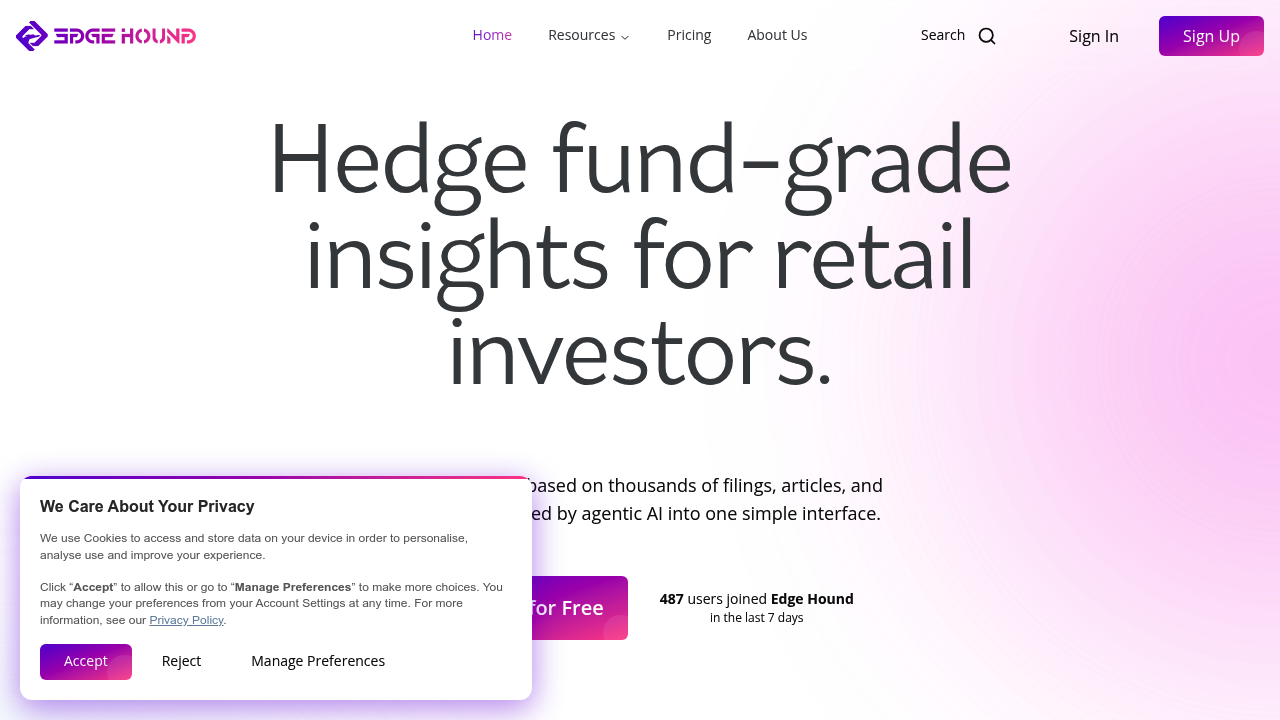
Edge Hound runs AI agents across hundreds of datasets simultaneously—SEC filings, earnings transcripts, financial news, social media chatter, forum discussions—to surface patterns retail investors typically miss. The system generates trade ideas that combine fundamental metrics, technical signals, sentiment scores, and breaking news into actionable insights. A swing trader gets real-time notifications when the AI detects imminent market movements based on coordinated signals across multiple data sources. An options trader uses the Discovery Bot to ask natural language questions like "why are semiconductor stocks diverging from chip equipment makers" and gets answers grounded in a Knowledge Graph that maps relationships between sectors, assets, and economic variables.
The sentiment analysis continuously scans financial news outlets, Twitter, Reddit, and stock forums to gauge market mood shifts before they show up in price action. Buzz Talk monitoring surfaces which stocks are generating unusual conversation volume and whether that chatter skews bullish or bearish. A momentum trader checks Most Active Buzz Talk to find stocks gaining social traction, then uses fundamentals analysis to validate whether the hype has substance. The corporate events calendar flags upcoming earnings, product launches, and regulatory filings that might move prices.
The system generates trade plans that outline entry points, exit targets, and risk parameters. But it won't execute trades—there's no brokerage integration yet, though that's under development. The natural language screener, portfolio analysis tools, and risk management features are also still being built. Free users hit walls fast: just 10 trade ideas monthly, one watchlist capped at 25 tickers, three chatbot conversations, and only one week of historical data. That's enough to test the interface but not enough to run a serious trading operation.
Basic plan holders at $9.99 monthly (billed yearly) get 50 trade ideas and 50 fundamental analyses per month with 10 watchlists. Active traders burn through those limits quickly. Standard at $49.99 monthly (yearly billing) provides 150 trade ideas, 250 fundamentals analyses, 100 watchlists, and extends history to six months for trade ideas and a year for fundamentals. Enterprise pricing stays custom for teams needing tailored terms.
The Knowledge Graph approach sets this apart from screeners that just filter numerical data. The AI simulates micro and macroeconomic scenarios to identify potential market turning points by understanding how variables interact. A value investor can trace connections between inflation data, commodity prices, and specific industrial stocks that standard charting tools won't reveal.
This doesn't work for passive index investors who don't need daily trade ideas. Buy-and-hold investors won't use sentiment monitoring. The service assumes you're actively researching individual stocks and want institutional-grade intelligence without institutional fees. Over 480 users joined in the past week, mostly retail traders tired of piecing together Bloomberg headlines, Reddit threads, and earnings reports manually. Edge Hound consolidates that research workflow but still requires you to make the actual trading decisions and execute them elsewhere.