
Doe - AI agents logo

Doe - AI agents

A finance director gets a Slack message at 4pm asking for Q3 P&L by EOD

28 views
Visit www.doe.so
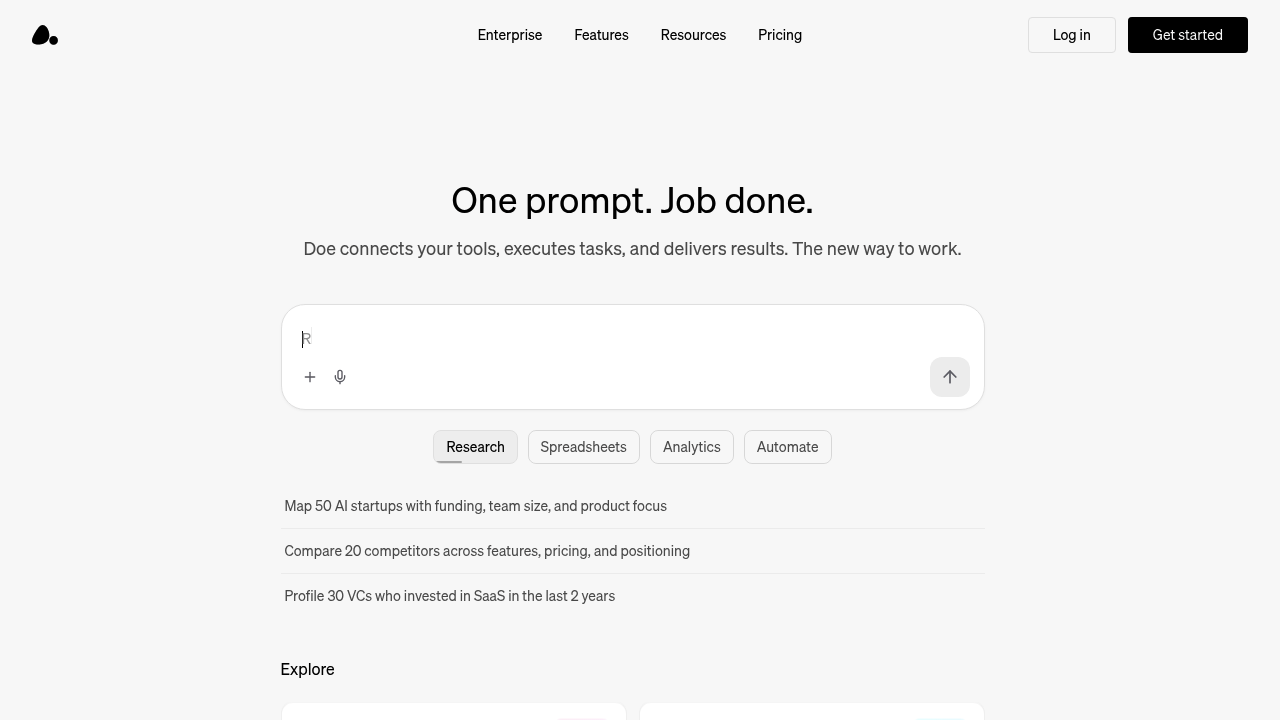
Doe - AI agents screenshot

A finance director gets a Slack message at 4pm asking for Q3 P&L by EOD. She'd normally spend three hours reconciling accounts across five systems, matching invoices to payments, calculating accruals, and formatting the report. She types a prompt into Doe describing what she needs. The AI agent pulls data from all accounting systems, reconciles discrepancies, generates the P&L, and delivers it formatted in 20 minutes. She reviews it, makes two adjustments, and sends it up the chain.

Doe executes multi-step work through natural language prompts. You describe a task, research competitors, build a financial model, create a prospect list — and the agent handles the execution by connecting your existing tools and delivering completed results. This isn't a chatbot that answers questions. It's an executor that does the work.

A product manager needs to understand which features actually drive revenue. Manually, she'd export data from analytics tools, cross-reference with billing records, build comparison tables, and calculate ROI across 15 features. With Doe, she asks for feature ROI analysis. The agent pulls usage data, matches it to revenue changes, builds the comparison tables, and delivers the analysis. She can then ask follow-up questions or request different cuts of the data.

The system handles complete workflows. A marketing manager can ask Doe to launch a campaign, and the agent researches the target audience, creates content, schedules posts, and monitors performance. An engineering lead dealing with a P1 incident can prompt Doe to identify root cause, rollback problematic deploys, and coordinate the response team. A finance team doing M&A work can request acquisition models, and the agent builds financials, pulls comparable company data, runs DCF analysis, and generates investment memos.

Tasks consume credits based on complexity. Simple queries burn through fewer credits than multi-step processes involving large datasets or multiple AI models. The free plan provides 150 credits monthly with a three-seat maximum and documentation support. That's enough to test the system but won't cover daily operational work for most teams.

Standard plans run $45 per user monthly when paid annually, providing 1,500 credits per user with unlimited seats and the Loops feature for recurring tasks. Pro accounts get 8,000 credits per user monthly at $225 annually, plus usage analytics, Slack support, and early beta access. Enterprise customers get custom credit volumes, dedicated account teams, SSO, VPC deployment, and uptime SLAs.

The credit system creates planning friction. You can't predict exactly how many credits a complex task will consume until you run it. A financial model request might use 50 credits or 500 depending on data volume and calculation complexity. Teams need to monitor credit burn rates and adjust usage or upgrade plans accordingly.

Doe works best for teams drowning in structured, repeatable work — monthly closes, pipeline analysis, competitive research, campaign launches. If your team manually builds the same spreadsheets, pulls the same reports, or performs the same multi-system workflows repeatedly, Doe automates that pattern.

It doesn't fit exploratory or creative work well. A brand strategist developing positioning concepts or a researcher conducting unstructured interviews won't get much value. The system executes defined tasks efficiently but doesn't replace strategic thinking or qualitative judgment.

Small teams experimenting with automation can start free. Growing teams running regular operational workflows should budget for Standard. Finance and ops teams processing high volumes of complex work will hit Pro-level credit needs quickly.


Frequently asked

7 questions
Does Doe have a free plan?
The free plan provides 150 credits monthly with a maximum of three seats and documentation support. That's enough to test basic workflows but won't sustain daily operational use for most teams. A marketing coordinator running one competitive research task and building a comparison table might use 40-60 credits, leaving enough for a few more simple tasks that month. Once you're running regular workflows like weekly pipeline analysis or monthly financial closes, you'll burn through 150 credits in days and need to upgrade to Standard at $45 per user monthly.
How much does Doe cost per month?
Standard plans cost $45 per user monthly when paid annually or $50 monthly, providing 1,500 credits per user with unlimited seats. Pro runs $225 per user annually or $250 monthly, delivering 8,000 credits per user plus usage analytics and Slack support. A three-person finance team running month-end closes and building acquisition models would likely need Pro since complex financial modeling with DCF analysis and comps can consume 200-400 credits per task. Enterprise pricing is custom with volume discounts, dedicated support, and VPC deployment for larger organizations.
What can Doe actually do?
A sales operations manager asks Doe to diagnose pipeline gaps, and the agent pulls data from the CRM, identifies where deals stall, builds comparison tables across regions and rep performance, and delivers the analysis. An engineering lead facing a P1 incident prompts Doe to identify root cause and coordinate response, and the agent traces the issue, rolls back the problematic deploy, and notifies the response team. A finance director requests month-end close, and Doe reconciles accounts across systems, matches invoices to payments, calculates accruals, and generates the P&L. The system executes complete multi-step workflows by connecting your existing tools and delivering finished results, not just answering questions.
How does Doe's credit system work?
Credits get consumed based on task complexity, where simple queries use fewer credits than multi-step processes involving large datasets or multiple AI models. A marketing manager building a basic prospect list might use 30 credits, while a finance team building a full acquisition model with financials, comps, DCF analysis, and an investment memo could consume 400-600 credits for that single request. You can't predict exact credit usage before running a task since it depends on data volume and process complexity. Teams need to monitor their credit burn rate and adjust usage patterns or upgrade plans when they're consistently hitting limits before month-end.
Who should use Doe?
A finance team processing monthly closes across five accounting systems, matching hundreds of invoices, and generating P&L reports will save hours of manual reconciliation work each month. An operations team running the same pipeline analysis every week or building recurring competitive research reports benefits from automating those structured patterns. A product manager who needs feature ROI analysis quarterly but spends most time on strategic roadmap decisions won't get enough value to justify the cost. Doe works for teams drowning in repetitive, structured workflows across research, spreadsheets, and multi-system processes, but doesn't replace exploratory work or strategic thinking.
What are Doe's limitations?
The credit-based system creates unpredictable costs since you can't know exactly how many credits a complex task will consume until it runs. A financial model request might use 50 credits or 500 depending on data volume and calculation steps, making monthly budget planning difficult. The free plan's 150 credits and three-seat maximum won't support operational use, forcing teams into paid plans quickly. A brand strategist developing positioning concepts or a researcher conducting unstructured qualitative interviews won't find value since Doe executes defined tasks efficiently but doesn't handle exploratory or creative work where the process itself is undefined.
Can multiple people use one Doe account?
Standard and Pro plans include unlimited seats, so a whole department can share one subscription with each user getting their own credit allocation. The free plan caps at three seats maximum, enough for a small team to test workflows together. A five-person finance team on Standard would get 7,500 total credits monthly with 1,500 per user, letting the CFO run acquisition models while analysts handle month-end closes and pipeline reports simultaneously. Each team member works independently with their own credit budget rather than sharing from one pool.

Reviews (0)

No reviews yet. Be the first to share your experience.

Similar tools

See all →