
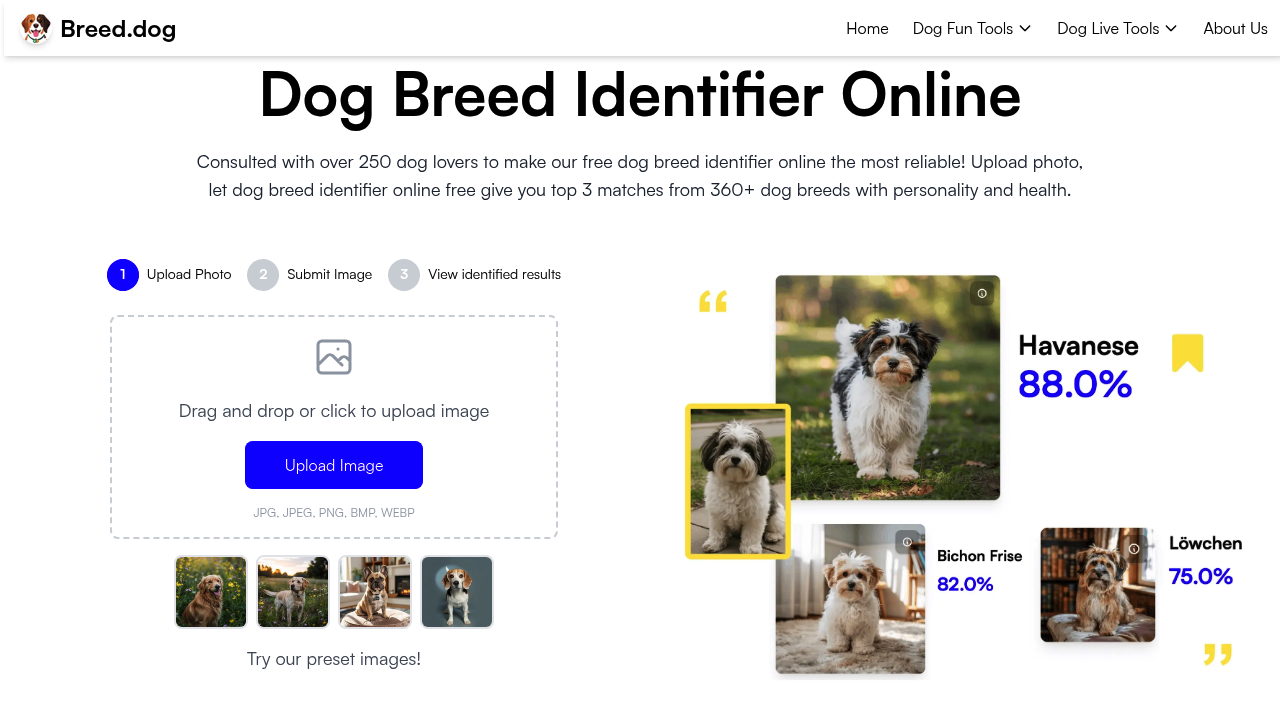
Dog owners upload a photo and get breed identification from a database spanning 360+ breeds across 100+ countries. The system analyzes the image and returns the top three breed matches, each accompanied by personality traits, health considerations, grooming requirements, and breed-specific facts. This addresses a real accuracy problem. Research from the University of Florida found that vets and shelter staff guessed breeds incorrectly nearly 75% of the time through visual assessment alone.
The upload process accepts JPG, JPEG, PNG, BMP, and WEBP formats through drag-and-drop or click-to-upload. Preset sample images let users test the system before uploading their own photos. Once analysis completes, results download as either an image file or PDF document. Each breed profile goes beyond basic identification to explain behavioral tendencies rooted in breeding history. Border Collies nip ankles, Terriers dig compulsively, Huskies howl instead of bark. Understanding these breed-driven behaviors helps owners distinguish training issues from hardwired instincts.
The development team consulted with over 250 dog lovers during creation. This input shaped how breed information gets presented, focusing on practical care implications rather than just physical descriptions. The breed profiles detail what grooming routines each breed needs, which health conditions show up more frequently in specific breeds, and how different breeds typically interact with families or other animals.
Everything works without account creation. No sign-up required. Users can upload unlimited photos and access all breed profiles completely free. The system positions itself as more consistent than human visual assessment while acknowledging it can't match DNA testing for definitive answers. DNA analysis remains the accuracy standard for breed identification.
Accuracy drops with mixed breed dogs since genetic inheritance doesn't follow predictable visual patterns. A dog might carry genes from three breeds but only show physical traits from one. Photo quality matters considerably. The system needs clear images with good lighting that capture both the dog's face and body structure. Blurry photos, poor angles, or bad lighting produce less reliable results.
This service targets dog owners trying to understand why their dog behaves certain ways and how breed background should inform training approaches. Someone with a herding breed learns their dog's constant movement and nipping stems from generations of selective breeding, not disobedience. This context changes how owners respond to behaviors and what training methods they choose. The service works best for purebred or predominantly single-breed dogs where visual markers align with genetic makeup.