
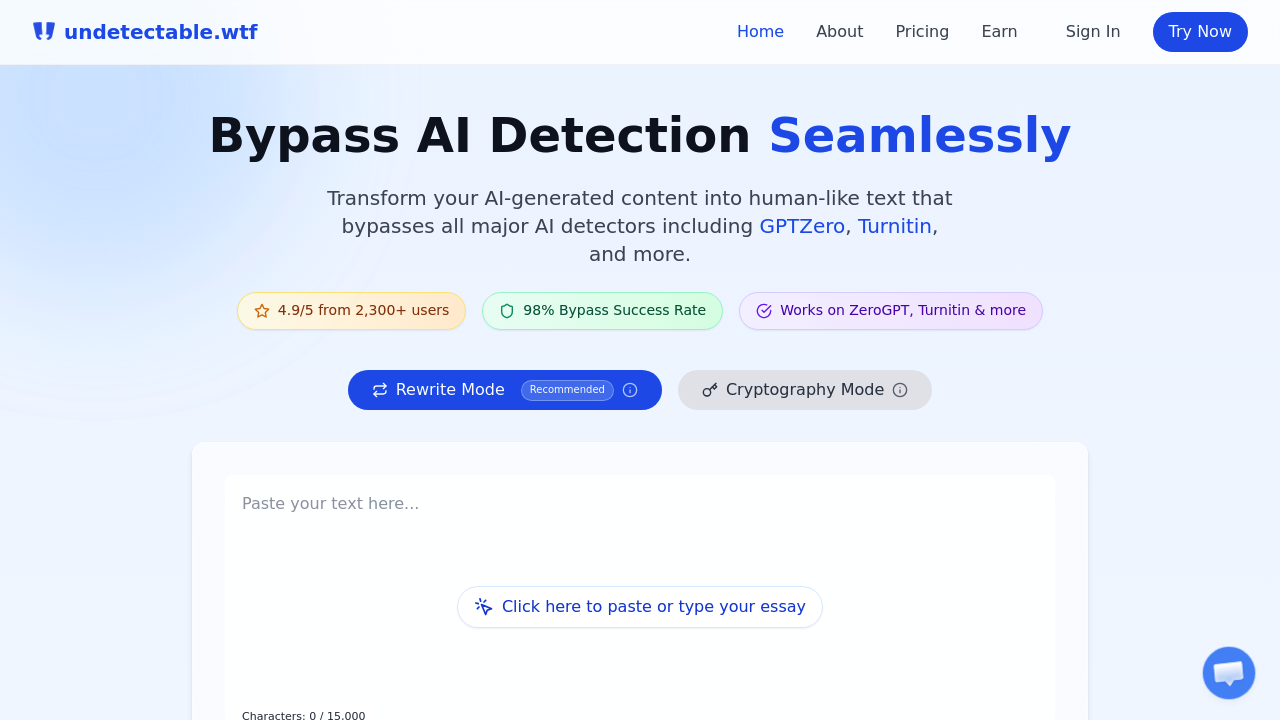
Students submitting AI-generated essays face a growing problem: detection software that flags their work. Undetectable.wtf tackles this by transforming AI-written content into text that passes through systems like GPTZero, Turnitin, and ZeroGPT without triggering alarms. The service claims a 98% bypass success rate across major detection platforms, backed by ratings from over 2,300 users who've given it 4.9 out of 5 stars.
This service operates through two distinct modes that handle text differently. Rewrite Mode takes AI-generated content and restructures it to sound natural, changing sentence patterns and word choices while preserving the original meaning. This approach creates authentically human-sounding text that detection algorithms struggle to identify as machine-generated. Cryptography Mode takes a different angle entirely. It keeps text visually identical for human readers but alters it in ways that make AI detectors unable to parse it properly. The content looks exactly the same when you read it, but detection software can't process it.
Each submission handles up to 15,000 characters, which translates to roughly 2,500 to 3,000 words depending on formatting. That's enough for most college essays and short research papers. The Standard plan doubles this capacity for Pro subscribers, letting them process larger documents in a single run.
The three-day trial provides full feature access with two free essays, no credit card required. Users get hands-on experience with both modes and the complete detection bypass system before committing financially. After the trial, the Standard plan runs $12.99 monthly and includes six essays per month with priority email support. The Pro tier costs $24.99 monthly and bumps the allowance to 15 essays while adding live chat support and early access to beta features. Yearly billing cuts costs substantially. Standard subscribers save $2.99 monthly, while Pro users save $5 monthly compared to month-to-month payments. That works out to 17% savings across both tiers.
The monthly essay limits create the primary constraint. Standard users working on six assignments monthly stay within bounds, but students juggling multiple classes or content writers producing high volumes will hit the ceiling. Pro's 15-essay limit accommodates heavier workloads but still caps usage. The 15,000 character limit per submission means longer research papers need splitting into multiple essays, eating into monthly allowances faster.
College students represent the core audience, particularly those using AI tools to draft papers who need to avoid academic integrity flags. High school students face similar detection systems. Graduate students working on thesis chapters or literature reviews fall into the target demographic. Content writers who use AI assistance but need their work to pass client detection checks find practical application here. Research assistants supplementing their writing with AI tools while maintaining human-sounding output also fit the use case.
The service doesn't offer API access for automation or team features for collaborative work. No browser extension exists for in-workflow integration. Mobile app availability isn't mentioned in the facts. Over 50,000 users have adopted this service, suggesting the essay-by-essay approach meets needs despite these gaps.
The cryptography approach distinguishes this service as the distinctive element. Most humanization tools simply rewrite content. This dual-mode system gives users options based on their specific situation and risk tolerance.