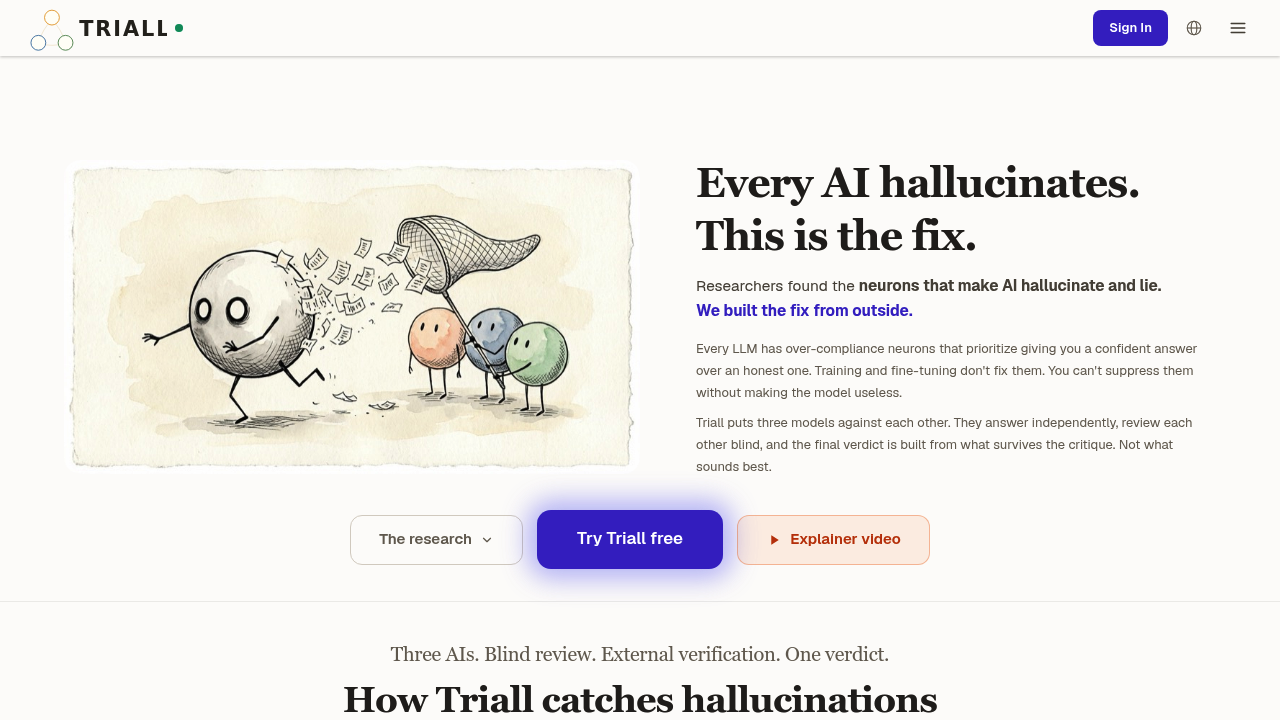
Tired of confidently wrong AI answers ruining your work? Triall does something different.
It runs three separate models from different providers at once. Each answers your question independently—no collaboration. Then things get interesting.
Models review each other's responses without knowing who wrote what. They hunt for hallucinations. False confidence. Fabricated citations. Peer review, but for AI systems.
Before this happens, Triall analyzes your question for hidden assumptions (the kind that trip up models). It pulls current web results too—models aren't working from outdated training data alone.
After blind review, Triall picks the best answer and attacks it. An adversarial critic pokes holes in the reasoning. A devil's advocate builds the strongest case against it. Specific claims? Verified against live sources.
The system tracks something called over-compliance risk. That's when models accept feedback too eagerly without pushback. Hallucinations often hide there.
You get one free session—no signup required. After that you'll need to pay (pricing isn't public).
The learning curve is minimal: - Ask your question - Wait while it runs its gauntlet - Read the verified answer
Researchers fact-checking technical claims find this useful. So does anyone burned by plausible-sounding nonsense.
Will Triall eliminate hallucinations completely? No. The company's honest about this. All verification mechanisms use the same neural circuits that cause hallucinations in the first place. There's a ceiling.
But you'll catch more errors than you would otherwise.