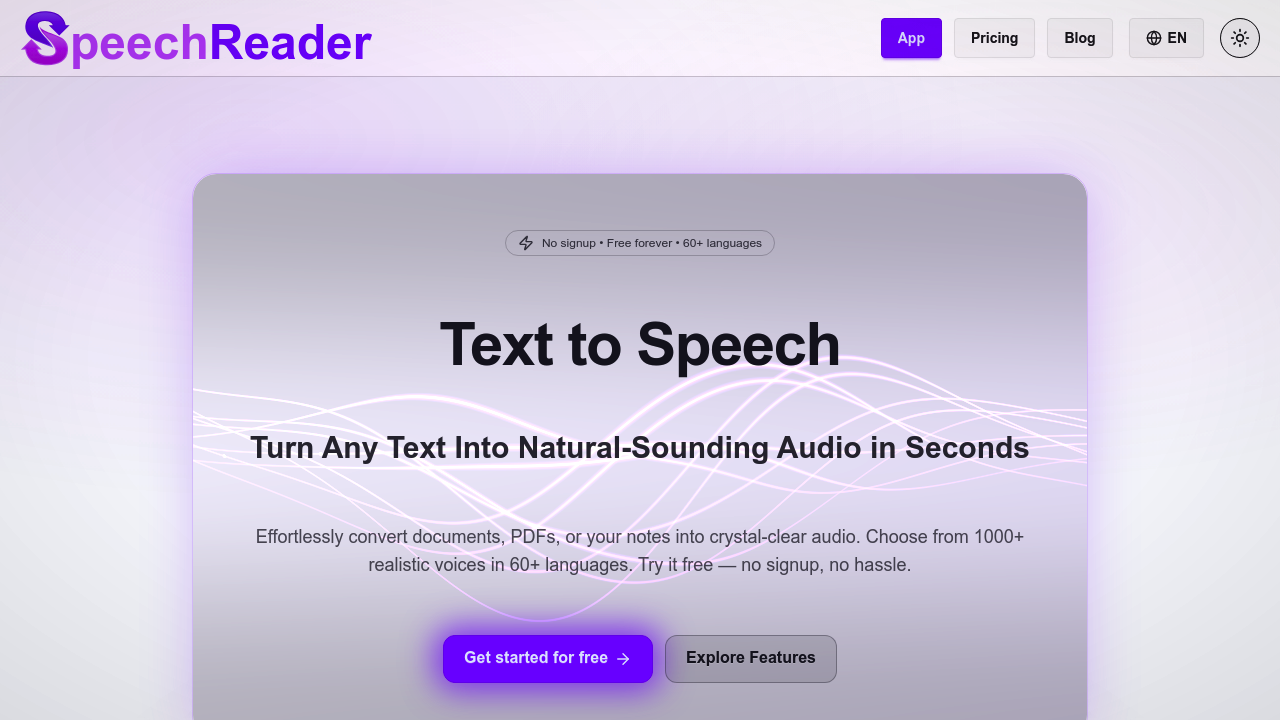
Text-to-speech technology transforms written content into audio, and SpeechReader handles this conversion across multiple file formats. This application accepts PDFs, images, and plain text, extracting readable content from each source and generating spoken audio through AI-powered voices. Users can paste text directly, drop files into the interface, or upload documents for processing.
The voice library spans 1000+ options across 60+ languages, giving users control over accent, tone, and speaking style. Premium voices deliver higher audio quality compared to standard options, though accessing these requires a paid subscription. The system processes uploaded PDFs by converting their text content into readable format first, then applies the selected voice. Images undergo similar transformation, with text extraction happening before audio generation begins.
No account creation blocks initial use. The free demo operates without signup requirements, letting anyone test the service immediately. This approach removes friction for first-time users who want to evaluate audio quality before committing. The "free forever" positioning means basic functionality stays accessible long-term, though with daily character restrictions.
Character limits define the practical boundaries of each tier. Free demo users get 1,000 characters daily, roughly equivalent to a few paragraphs or a short article. The Basic plan jumps to 100,000 characters per day, enough for multiple lengthy documents or several academic papers. Premium subscribers receive 500,000 daily characters, accommodating heavy usage patterns or batch processing needs. These limits reset every 24 hours.
Pricing follows an annual billing model. Basic costs $3.83 monthly when paid as a $45.99 yearly charge. Premium runs $8.25 monthly, billed at $99.00 annually. Both paid tiers enable audio downloads in MP3 format, premium voice access, PDF text transformation, and image text transformation. Priority support comes standard with paid subscriptions, replacing the email-only support available to free users. The annual commitment delivers 45% savings compared to hypothetical monthly pricing.
Several features stay locked behind the paywall. Free demo users can't download generated audio files, limiting them to in-browser listening only. Premium voices remain inaccessible without upgrading. PDF and image processing capabilities don't function on the free tier, restricting free users to pasted text input exclusively. These restrictions push document-heavy users toward paid plans quickly.
This application targets specific use scenarios where eyes and hands stay occupied. Commuters can listen to articles during drives. People cooking can hear recipes read aloud. Accessibility needs get addressed for users with visual impairments or reading difficulties. Content creators might use it to review their written work through audio playback, catching errors that visual proofreading misses. Students and researchers can consume dense academic material while exercising or doing household tasks.
Character quotas create the primary limitation for active users. Someone processing multiple long documents daily will exhaust even the Premium tier's 500,000 character allowance with extensive use. No API access exists for developers wanting to integrate the service into other applications. Team collaboration features aren't mentioned, suggesting individual use remains the focus. The lack of mobile app or browser extension means accessing the service requires visiting the website directly each time.