
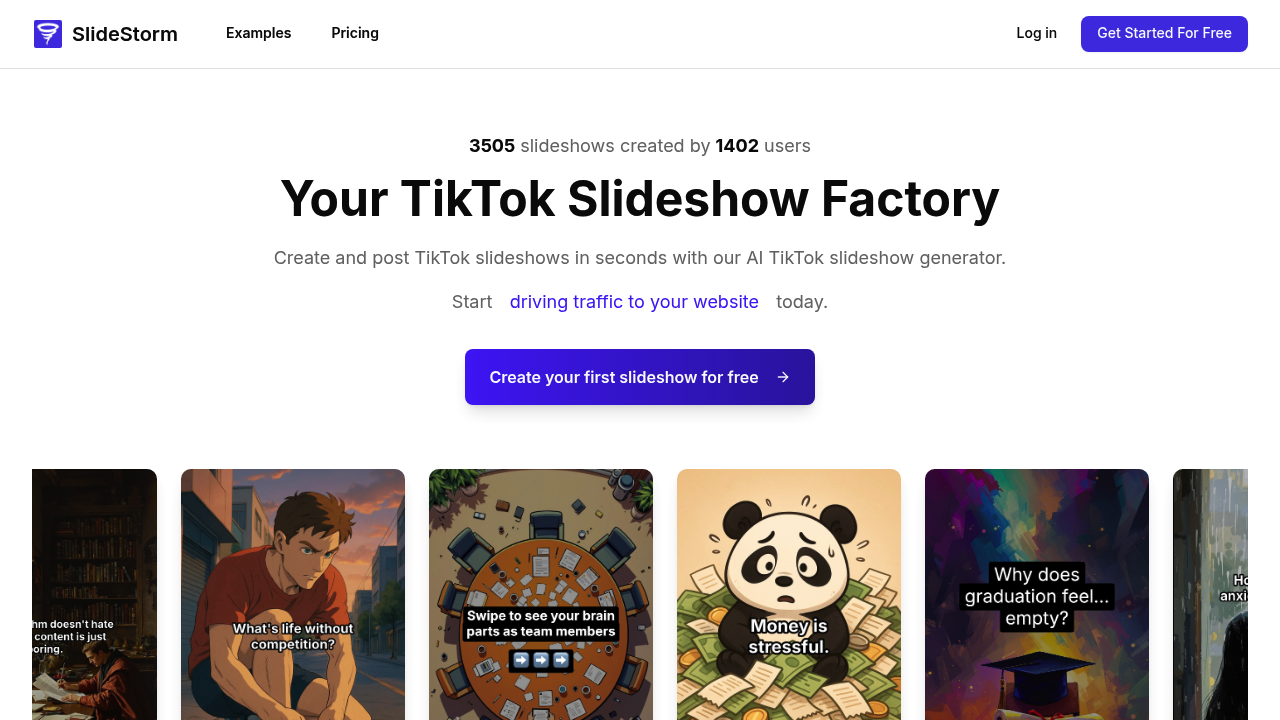
SlideStorm generates TikTok slideshows through an AI system that takes text prompts and converts them into formatted video content. This service handles the entire creation pipeline from image generation to final video assembly, letting users produce TikTok-ready slideshows without touching design software.
The technical workflow starts with prompt processing. Users describe what they want, and the system interprets that input to generate or select appropriate images. The AI can create custom images from scratch using three credits per image, or users can pull from the built-in stock library at no credit cost. Each slideshow generation consumes one credit regardless of image source. The bulk generation feature processes up to ten slideshows from a single prompt, useful for content batching.
Character consistency presents a common challenge in AI image generation. SlideStorm addresses this by maintaining visual coherence across multiple images and slideshows when working with the same characters. This matters for creators building narrative content or branded personas where visual continuity impacts audience recognition.
The slideshow editor operates as a post-generation adjustment layer. After the AI assembles the initial output, users can modify captions, swap images, and adjust layout elements. This editing happens before scheduling, giving creators control over the final product without restarting generation. The system supports image uploads up to plan-specific limits, ranging from 300 to 1000 images depending on subscription tier.
SlideStorm connects directly to TikTok accounts for scheduling and posting. The integration handles authentication and content delivery to TikTok's platform. Account connection limits scale with pricing tiers from five accounts on the Starter plan to 100 on Premium. This architecture supports creators managing multiple faceless accounts or running TikTok presences for different projects simultaneously.
The credit system operates on monthly allocations that accumulate rather than reset. Unused credits carry forward indefinitely. Starter provides 300 credits monthly, Pro delivers 900, and Premium includes 2100. Since slideshow generation costs one credit and AI images cost three, a Starter subscriber could theoretically generate 300 slideshows using only stock images, or 75 slideshows if every image required AI generation.
This service reports 3505 slideshows created across 1402 users. These numbers suggest moderate adoption rather than massive scale. The user base skews toward content creators running faceless TikTok accounts, software developers promoting apps, and online business owners driving traffic through short-form video.
Technical limitations center on the credit economy and account restrictions. Bulk generation caps at ten slideshows per prompt, requiring multiple prompts for larger batches. Image upload quotas constrain users building libraries of custom assets. The TikTok-only integration means this software doesn't extend to YouTube Shorts, Instagram Reels, or other short-form platforms.
Pricing starts at $19 monthly for Starter access. The first slideshow generates free, letting users test the output quality before committing. Pro costs $49 monthly and Premium runs $99 monthly, with the primary differentiators being credit allocation and account connection limits rather than feature access. Priority support appears at Pro level and above.
The system doesn't require design expertise since the AI handles layout and composition decisions. This lowers the barrier for creators who understand their content niche but lack visual design skills. The tradeoff involves less granular control compared to manual slideshow creation in dedicated video editing software.