
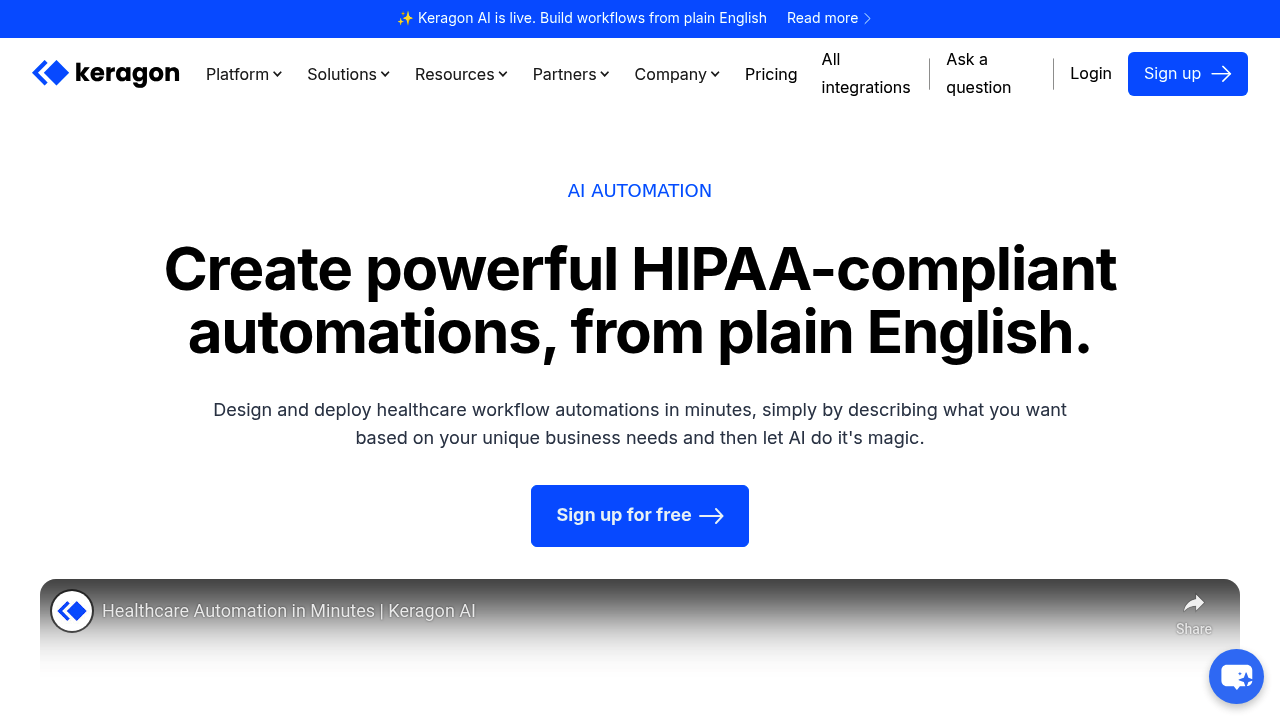
A medical office manager at a dermatology practice spends hours each week manually routing referrals between their EHR, scheduling system, and patient communication tools. She types "When a new referral comes in, check insurance eligibility, assign to the right provider based on specialty, and send appointment options to the patient" into Keragon's AI workflow builder. The system generates a complete automation plan with all the logic, field mappings, and conditional branches already configured. She reviews it on the visual canvas, toggles a few settings, and publishes. Done.
That's what Keragon does. It turns plain-English descriptions into working healthcare workflow automations without requiring technical skills or manual connection-building. The AI Workflow Engine understands healthcare processes, recognizes which apps need to talk to each other, and builds the automation structure automatically. It maps data fields between systems, adds conditional logic for different scenarios, and handles multi-step processes that run over days or weeks.
A solo practitioner running a mental health practice uses it to automate patient intake. Forms submitted through Jotform trigger workflows that verify insurance, schedule initial consultations, send pre-appointment questionnaires, and route urgent cases to immediate attention queues. The system handles error detection and fixes issues without manual debugging. If a patient's insurance provider doesn't match expected formats, the workflow adapts instead of breaking.
Keragon's built specifically for healthcare with HIPAA-compliant infrastructure and zero AI data retention. Protected health information never trains the underlying models. Every healthcare organization gets a Business Associate Agreement regardless of plan tier. End-to-end encryption covers all data in transit and at rest.
A digital health startup with three full-time employees uses it to connect their telehealth platform with Athenahealth and Slack. Appointment reminders go out automatically, no-shows trigger rescheduling workflows, and clinical staff get notifications about urgent patient messages. The AI Editor toggle lets them switch between describing workflows in natural language and manually adjusting them on the visual builder when they need precise control.
Where Keragon doesn't fit: organizations running more than 20,000 workflow executions monthly hit the Scale Up Plan's ceiling and need to jump to custom enterprise pricing. The Starter Plan's 200 monthly runs work for very small practices but fill up fast if you're automating multiple daily processes. Three published workflows means you can't test and iterate extensively before committing. Teams needing dozens of different automation types find the 15-workflow limit on the Professional Plan restrictive.
Keragon integrates with Jotform, Slack, and Athenahealth directly. That's the confirmed list. If your practice runs entirely on different systems, you'll face integration gaps. 500-plus healthcare companies use Keragon, which suggests reasonable reliability but isn't the massive user base of general automation tools.
Pricing starts at $99 monthly for the Starter Plan with 200 workflow runs and costs $0.15 per additional run. The Professional Plan runs $269 monthly for 2,000 runs at $0.07 each extra. Scale Up costs $995 monthly for 20,000 runs with $0.02 overflow pricing. Enterprise plans use custom pricing with volume discounts. All tiers include the standard Business Associate Agreement.
Small practices automating just a few processes fit the Starter tier. Medium practices handling thousands of patient interactions monthly need Professional or Scale Up. Large hospital networks require Enterprise. Non-healthcare organizations shouldn't bother. The entire product assumes healthcare compliance needs and workflow patterns. A marketing agency or e-commerce business would find the feature set oddly specialized and miss standard automation capabilities.