
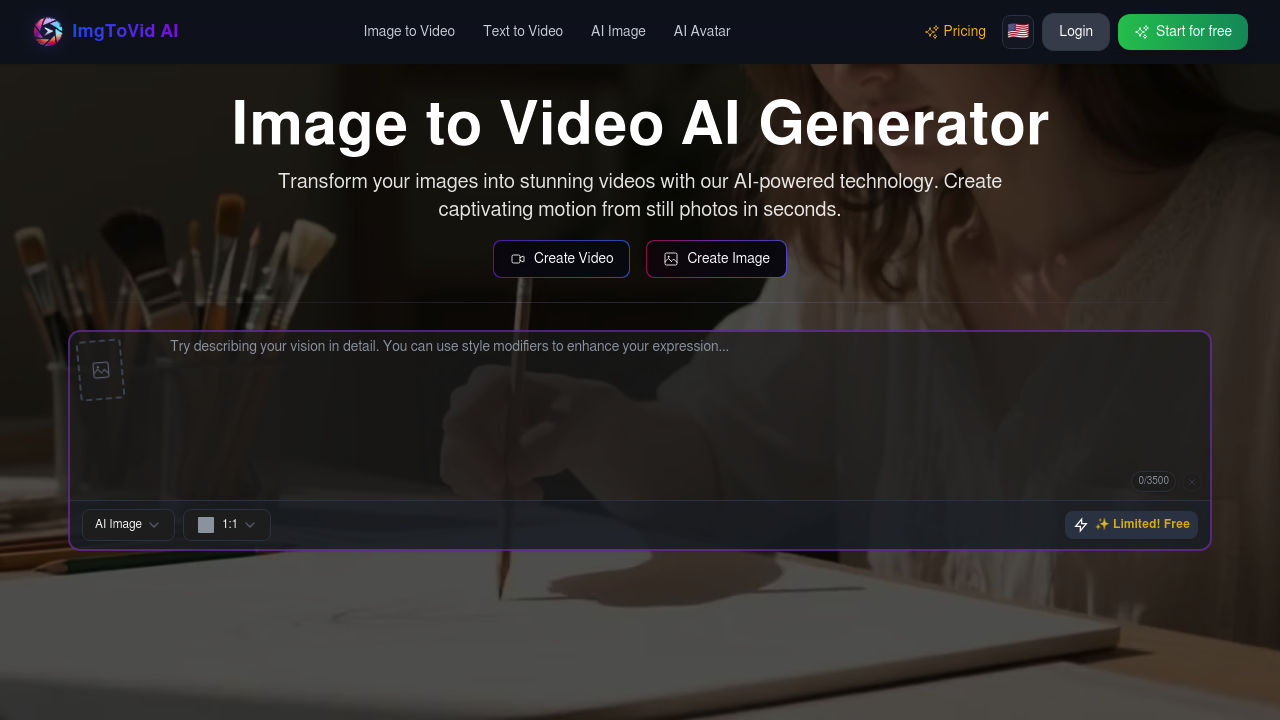
This service processes static images through neural networks that analyze spatial features and generate interpolated frames to create motion sequences. Users upload JPG, PNG, or WEBP files, then provide text prompts that guide how the algorithm interprets and animates the content. The system works with multiple input methods including direct image uploads for animation and text-to-video generation that creates moving content from descriptions alone.
Processing happens server-side with typical completion times between 5 and 10 minutes depending on complexity. The machine learning models analyze the source image's composition, identify objects and subjects, then apply motion algorithms based on the text instructions. This creates intermediate frames that bridge the static input to a moving sequence. The service maintains access to multiple AI models, allowing users to switch between different neural network architectures for varied animation styles.
The credit system structures usage around video and image generation capacity. The Starter plan allocates 36000 credits annually, translating to roughly 360 videos or 7200 images depending on complexity. Premium doubles this to 66000 credits for 660 videos or 13596 images. Advanced provides 156000 credits supporting up to 1560 videos or 31992 images. Credits persist even after subscription cancellation, which differs from typical services that forfeit unused allocations.
Security implementation uses bank-level encryption protocols for data transmission and storage. The system stores video history, allowing users to retrieve previously generated content. Commercial licensing comes standard across paid tiers, removing usage restrictions for business applications. Direct social media integration enables sharing to various sites without downloading and re-uploading, though the specific APIs and platforms are not detailed.
The prompt generator assists users who struggle with effective text descriptions for motion guidance. This feature likely uses templates or suggestion algorithms to help structure instructions that the animation models interpret more accurately. All paid tiers access this functionality along with the complete model library.
Free tier availability exists but carries a 0 of 3500 limit constraint and restricted features. The pricing structure starts at nineteen dollars ninety cents monthly for Starter, thirty-four ninety for Premium, and sixty-two ninety for Advanced. Annual subscriptions provide the full credit allocation upfront with a thirty percent discount compared to monthly billing.
The technical limitation around processing time means real-time generation is not possible. Users submit requests and wait several minutes for completion, making it unsuitable for workflows requiring immediate output. The credit-based system also caps monthly production volume, though the rollover policy mitigates waste from unused allocations.
The software doesn't specify which neural network architectures power the animation, whether it uses diffusion models, GANs, or other approaches. The image format support covers standard web formats but doesn't mention resolution limits or aspect ratio constraints. Video output specifications including frame rate, resolution, and codec options aren't documented in the available information.
Avatar creation functionality exists as a separate feature, presumably generating animated characters from text descriptions or reference images. How this integrates with the primary image-to-video pipeline or whether it uses distinct models remains unclear. The system's ability to handle different content types suggests multiple specialized models rather than a single general-purpose architecture.