
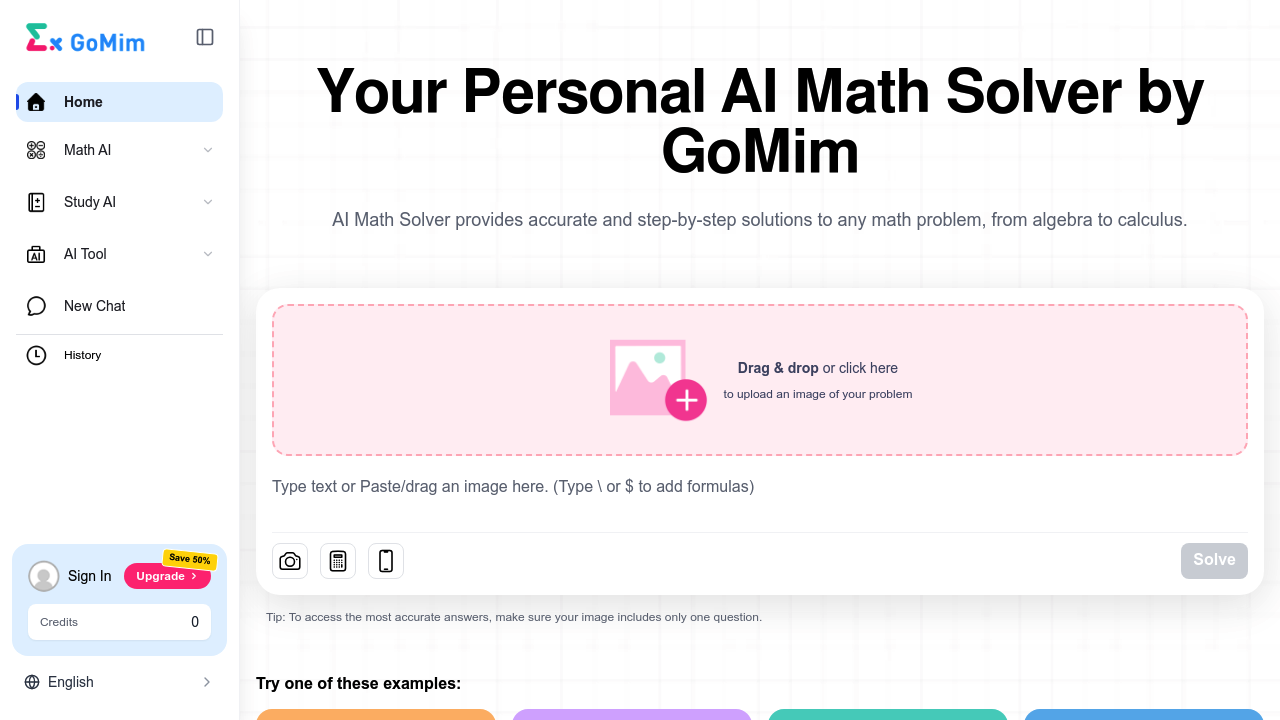
A high school junior stares at a calculus problem at 11 PM. She's stuck on an integral involving trig substitution. She snaps a photo of her handwritten work with GoMim, and within seconds gets a step-by-step breakdown showing exactly where her substitution went wrong. The AI walks through each transformation, explains why the bounds change, and shows the final answer. She can ask follow-up questions about any step she doesn't understand.
GoMim tackles math problems across algebra, calculus, geometry, and statistics by accepting both photos and text input. A middle school teacher uses it during office hours when three students need help with different topics simultaneously. One kid uploads a printed worksheet on quadratic equations, another types in a statistics word problem, and a third photographs a geometry proof. The software handles handwritten scribbles just as well as typed formulas or printed textbook pages.
The step-by-step explanations break down each problem into digestible chunks. Word problems get special treatment where the AI first translates the scenario into mathematical equations before solving. A college student struggling with a stats problem about probability distributions sees GoMim extract the relevant numbers, set up the formula, and work through the calculation while explaining what each step accomplishes.
Two response models offer different speeds and depth. Quick Response handles straightforward problems fast. Think Deeper takes longer but provides more detailed reasoning for complex multi-step problems. The free tier includes Quick Response with 10 credits daily, which works fine for occasional homework help but runs dry fast if someone's cramming for an exam. Question history lets users review past problems, though there's no way to organize them into folders or study sets.
The 99.9% accuracy claim draws from an archive of over 100 million solved problems. Graph interpretation helps when textbooks show visual data that needs analysis. The 24/7 support means students working at odd hours don't hit dead ends, though response quality probably varies with problem complexity.
PRO at $4.99 monthly grants 5,000 credits and enables Think Deeper. That's roughly 167 credits daily if spread evenly, enough for serious exam prep. Unlimited at $7.49 removes credit caps entirely, suited for tutors or students taking multiple math-heavy courses. Yearly plans cut costs by half.
The software falters with truly advanced graduate-level mathematics or proofs requiring creative insight rather than procedural steps. A PhD student working on topology probably won't find much help. Problems requiring context beyond pure mathematics, like applied physics scenarios needing domain knowledge, might get incomplete explanations. The Think Deeper model stays locked behind paid tiers, so free users tackling particularly difficult problems can't access the better AI reasoning.
Someone taking one math class who hits a wall occasionally will stretch the free 10 daily credits. A student juggling calculus, statistics, and physics burns through that quota before lunch. Teachers checking student work across multiple classes need unlimited access.
GoMim doesn't replace understanding concepts. A student who photographs every homework problem without reading the explanations learns nothing. It works best as a check-your-work resource or study guide when lectures didn't click. The lack of organizational features means it's not built for long-term exam preparation where categorizing problems by topic matters.
Skip this if math isn't your bottleneck or you need collaborative features for group study. It's a solo resource focused entirely on getting unstuck, not building study groups or sharing solutions with classmates.