
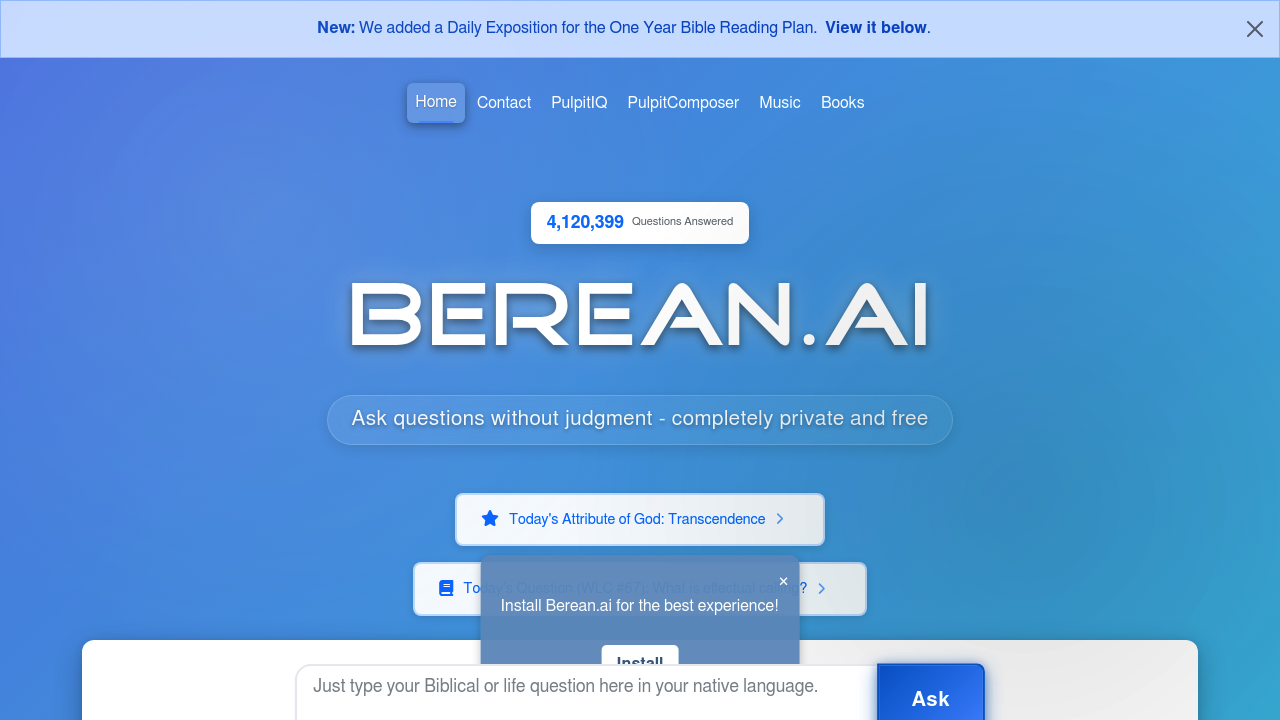
This AI theology tool answers biblical questions through a chat interface. Over 4.1 million questions answered so far, which suggests steady adoption among people who want biblical guidance without walking into a church office or texting their pastor at odd hours.
The core promise is privacy. You can ask anything close to scripture, theology, or faith without worrying someone's keeping track. That matters when you're wrestling with doubts or exploring interpretations that don't match your community's teaching. The interface stays completely free with unlimited questions.
Beyond the Q&A function, you get structured daily content. Daily expositions follow the One Year Bible Reading Plan, breaking down assigned passages. Daily devotions provide shorter reflections. There's a daily attribute of God feature and daily questions from the Westminster Larger Catechism. These additions work if you want built-in structure rather than just ad-hoc questions.
What's unclear is how the AI handles theological disagreements. Christianity spans Catholics, Orthodox, dozens of Protestant denominations, each with distinct doctrines on baptism, communion, salvation, church authority. The service doesn't specify which theological tradition guides its answers. Does it default to evangelical Protestant views? Reformed theology? Something ecumenical? That ambiguity matters when advice on infant baptism or predestination varies wildly between traditions.
The catechism questions lean Reformed Protestant, which signals something about theological orientation but doesn't clarify how the AI handles contested interpretations. For straightforward biblical literacy questions, that's probably fine. For thornier doctrinal issues, you're trusting an opaque theological framework.
The privacy angle and zero cost make it accessible. Just know you're getting one AI's interpretation of complex texts with thousands of years of competing scholarly and denominational readings behind them.