
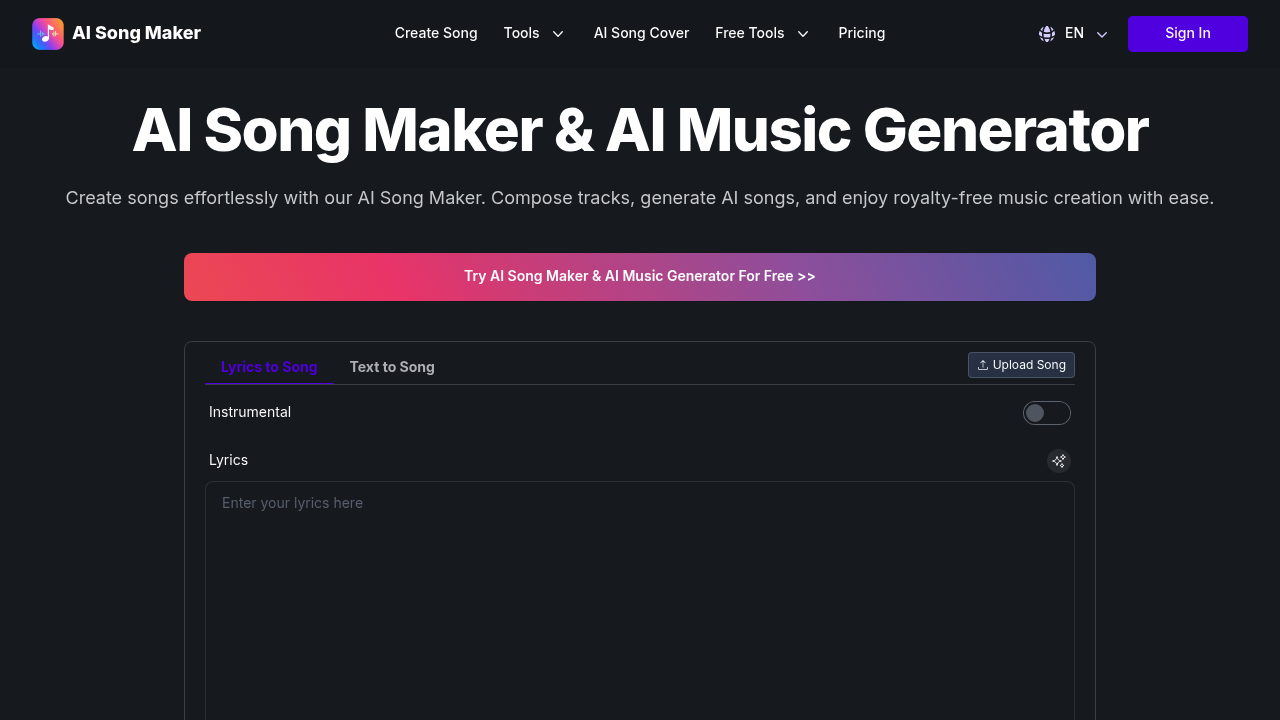
You type in some lyrics or just describe what you want, and AI Song Maker spits out a complete track in about a minute. The service handles everything from full instrumental compositions to vocal covers, plus it'll write lyrics for you if you're starting from scratch. The lyrics generator lets you specify theme, genre, emotion, tempo, and even language before it generates anything.
The feature set goes beyond basic text-to-music conversion. You can train custom voice models, remove vocals from existing tracks, or create what they call AI Singing Photos. Upload your own music files as reference material. Choose male or female voices, mix genres and vibes, exclude styles you don't want. Downloads come in MP3, WAV, or MIDI formats depending on your plan.
Does the generation quality hold up? Each creation is supposedly unique, which matters for royalty-free content. But there's a hard limit on what you can feed it (you can't use famous names in lyrics or titles, and they filter out sensitive words). That's restrictive if you're trying to create parody content or reference real people. The free plan caps uploads at one minute, which feels tight when you're working with sample material.
Storage is another weak point. Free users only get 30 days of cloud storage before their songs disappear. That's not archival thinking. You're forced to download everything immediately or lose it. The free plan also restricts you to one concurrent generation, so no batch processing multiple ideas. You get 20 credits daily, which translates to four songs. That's actually decent for testing, but you'll blow through it fast if you're iterating on a project.
The credit system is the whole pricing model. Free gets you those 20 daily credits. Basic starts at $10.49 monthly when billed yearly, giving you 12,000 credits annually — that's 2,400 songs. Standard jumps to $20.99 monthly (yearly billing) for 30,000 credits and 6,000 songs. Pro hits $41.99 monthly (yearly) with 72,000 credits and 14,400 songs. Monthly billing costs about 30% more across all tiers. Subscribers can buy one-off credit packs that never expire, but free users can't access those.
Higher tiers provide practical stuff. Standard and Pro let you upload eight-minute audio files instead of two. They give unlimited custom voice models instead of 100. Unlimited cloud storage instead of time limits. WAV and MIDI downloads appear at Standard tier. Pro adds unlimited concurrent generations, which matters if you're running a content operation.
Who actually needs this? Content creators churning out background music for videos. Musicians sketching ideas before proper production. Social media people who need quick audio without licensing headaches. Anyone producing volume work where royalty-free matters more than having a platinum-sounding mix.
The one-minute generation speed is legitimately useful. Traditional music production takes hours. This gives you a starting point or finished piece in 60 seconds. The commercial license availability means you can actually use this stuff in paid projects without legal anxiety.
But you're working within guardrails. The content filters, storage limits, and upload restrictions all push you toward paid tiers if you're doing serious work. The free version is a test drive, not a long-term solution.