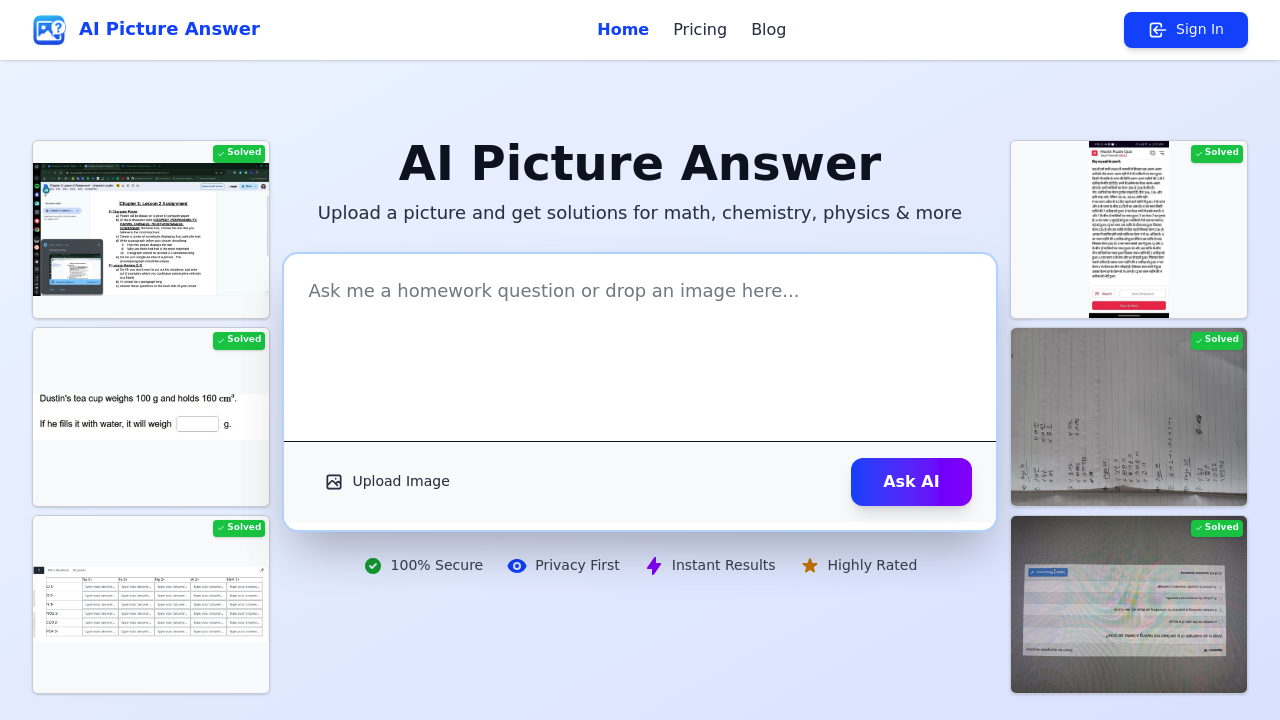
A college chemistry student stares at a handwritten stoichiometry problem at 11 PM. The textbook explanation makes no sense. She snaps a photo with her phone, uploads it, and gets a step-by-step breakdown showing exactly where to start and how each calculation connects. The handwriting recognition reads her messy numbers correctly. She works through three more problems the same way, comparing her work against the solutions until the pattern clicks.
High school students use this for algebra homework during study hall. They photograph textbook pages or their own written work. The system handles equations, word problems, and geometry diagrams. Math coverage spans algebra through calculus, including trigonometry and statistics. But chemistry gets deeper support than most homework solvers, organic chemistry mechanisms, balancing complex equations, stoichiometry chains, and periodic table questions all work. Physics problems covering mechanics, thermodynamics, electricity, and quantum physics get the same treatment. Biology questions about genetics, cell processes, and anatomy also qualify.
Over 100,000 students rely on it daily. The accuracy rate sits at 98% across 10,000+ problems solved each day. Response time stays instant. No waiting for tutors or forum replies.
A university physics major photographs a handwritten mechanics problem at 2 AM before an exam. Gets the solution immediately. Works backward through the steps to understand the approach. Uses all ten free daily solves practicing similar problems until the method sticks. The free tier resets every day, giving another ten attempts.
The service covers 15+ subjects beyond STEM. History questions work. So do literature and language problems. But the real strength lives in technical subjects where step-by-step math matters most. Each explanation breaks down why each step happens, not just what to do.
Students taking five different classes can handle all their homework through one app. No switching between specialized apps for each subject. The same upload process works whether it's a calculus integral, chemical reaction, or biology diagram. Both printed textbooks and handwritten notes scan equally well.
It breaks when problems need creative writing or subjective analysis. English essays don't fit. Neither do open-ended research questions or projects requiring multiple sources. The service solves discrete problems with clear answers. Ambiguous assignments fall outside that scope.
Ten free solves per day covers light users. Students hitting that limit consistently can grab 1,000 credits for $10. That's one cent per problem. Credits never expire, so buying once handles sporadic heavy-use periods. A student might burn 50 credits during midterm week, then use nothing for a month. The 950 remaining credits just wait. API access comes included with paid credits for anyone building custom integrations.
The pay-per-use model means no subscription pressure. No monthly fees mounting up during summer break. But it also means no subscription option for students who'd prefer predictable monthly costs. You either use the free tier or buy credit blocks.
Someone needing live tutoring interaction won't find it here. No chat with human experts. No back-and-forth clarification. You get one AI-generated solution per upload. Students who learn better through conversation need different options. Same for anyone wanting practice problem sets generated fresh — this solves existing problems, doesn't create new ones.
The 7-day refund window only applies if you haven't touched your credits yet. Use even one, and the purchase sticks.
Best fit: students juggling multiple STEM classes who need quick solution checks and step breakdowns. Worst fit: anyone wanting human interaction or subscription billing.